Magazine
TV stand with fireplace: design, dimensions, and prices
Complete guide to choosing a media center with an integrated fireplace, dimensions, styles, safety, and real cost.

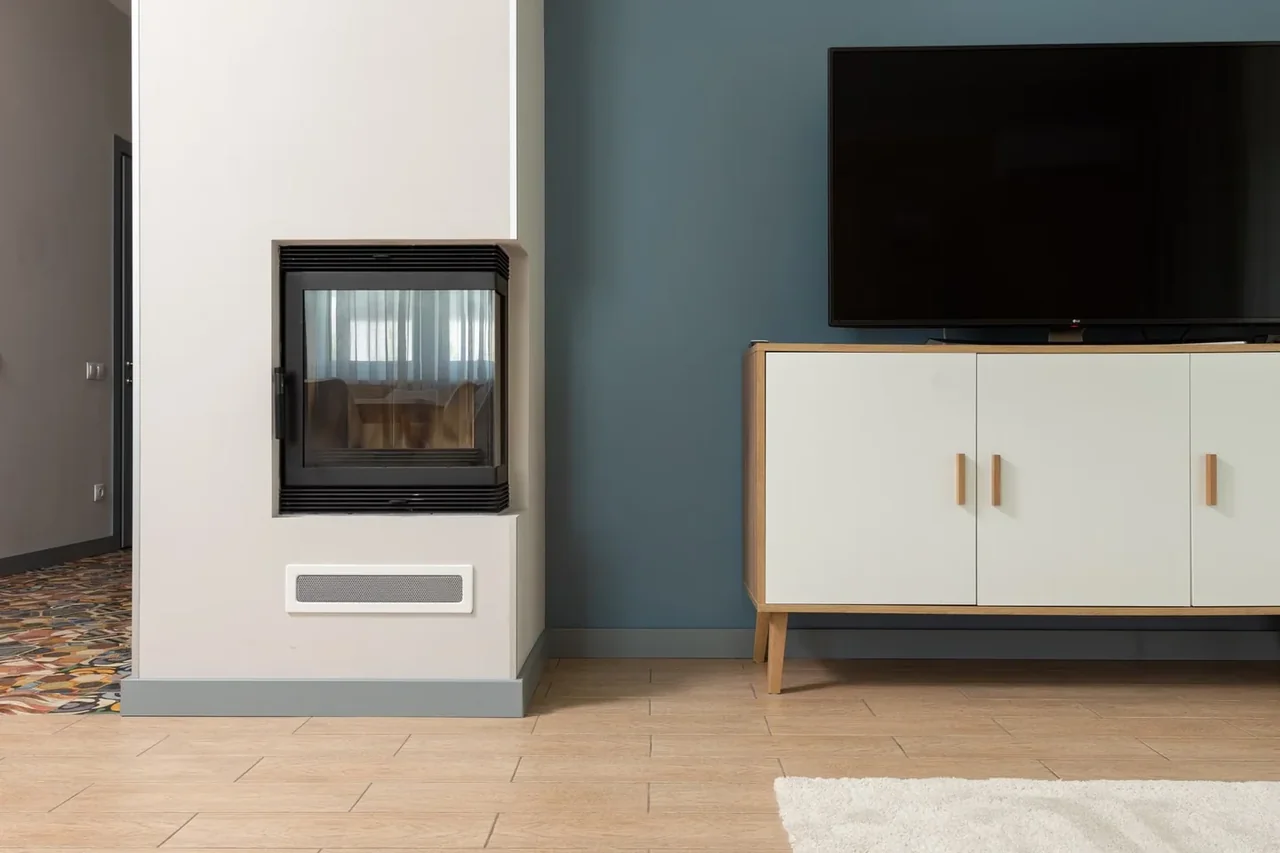
The contemporary living room has turned the TV area into a meeting point far more ambitious than a simple wall with a screen. The TV stand with fireplace responds to that evolution: it combines storage, visual presence, and a decorative flame that adds atmosphere without requiring renovations or a flue. In today’s market, the dominant formats range from 150 to 368 cm wide, with finishes in oak, black, beige, or cement and prices that, depending on design and brand, start at just over 219 euros and can exceed 1,000 euros for premium offerings.
Its appeal is not only visual. It also solves a very specific modern-home problem: bringing together in a single piece the TV support, cable management, space for remotes, consoles and players, and a sense of warmth that used to depend on a traditional fireplace. The difference is decisive in houses and apartments, where the integrated electric fireplace runs from a standard power outlet, can be used with or without heat, and offers a cleaner, quieter, and more predictable experience than real fire.
If you have a problem with your washing machine, you can use our free error code finder. From there, you can easily and effectively find out and solve all errors.
Why this type of furniture has gained ground in living rooms
The key is that it combines two languages that used to live apart: the practical logic of multimedia furniture and the emotional narrative of fire. A low TV stand with fireplace does not just support the screen; it builds a scene. When the LED flame reflects off the wood finish or a white lacquer, the living room changes texture, as if the atmosphere drops a tone and gains depth. That effect explains why this format has spread so widely in interior design catalogs and major online stores.
The range has also matured. Today, compact versions designed for TVs up to 55 or 65 inches coexist with larger compositions for screens up to 80 or 90 inches. Some pieces include doors, drawers, or open shelves; others favor visual cleanliness with smooth fronts and suspended modules. In all cases, the goal is the same: that home technology does not break the harmony of the space, but instead integrates into it with a warmer and less cold presence than a conventional stand.
Stylistic versatility also matters. Oak tones evoke natural warmth, black fits modern or industrial interiors, and cement brings a more urban reading. The fireplace, meanwhile, acts as the common thread. Even when the heating is off, the movement of the flame maintains a hypnotic presence, almost like a small domesticated bonfire behind glass. That image, highly recognizable in today’s market, explains why many buyers see it as a central piece in the living room rather than just an accessory.
Measurements matter more than you might think
Choosing well depends on more than style. Proportions matter. In the actual market, widths appear at 150, 158, 160, 200, 208, 210, 212, 237, 267, 288, 310, 315, 317, and 368 cm, with common depths of 35 cm and heights that usually range between 45 and 57 cm. That range is no accident: it responds to the need to balance the TV viewing height with the placement of the fire module and useful storage space.
A 150 or 160 cm model works better in small living rooms or on short walls, where a stand that is too long would visually swallow the space. By contrast, compositions of 267, 288, or 368 cm call for larger rooms, less low ceilings, and a bit of lateral breathing room so the set does not look forced in. The 35 cm depth, very common in the category, offers a reasonable compromise between stability and visual lightness, although it is always wise to check the screen’s weight and the support base it requires.
Height also has an ergonomic reading. The 45 cm models place the TV lower, which usually favors relaxed viewing from a standard sofa; the 57 cm ones raise the eye line slightly and can be more comfortable when the seating is taller or the TV is mounted somewhat higher than usual. It is not a minor detail: a single poorly handled centimeter in the scale of the living room can make the whole set look balanced or awkward, like a table that does not speak to the wall holding it up.
Here, the length of the screen matters as much as the width of the stand. A large-format TV on a base that is too short breaks proportion and leaves the whole set without visual support. That is why, on pieces of 200 cm or more, the result usually looks more stable and architectural, while compact formats work better in corners or living rooms where the TV is not meant to be the only star of the space.
Integrated electric fireplace: what it offers and what it does not promise
The integrated fireplace is the emotional heart of the set, but its technology should be understood without embellishment. In most current models, the flame is a visual effect created with LED, reflections, and internal movement. Some units add heating and others are limited to the decorative effect, which is very useful in warm months or in homes where the main goal is atmosphere, not heat. That difference is clearly reflected in the market: there are without heating function versions and others with common outputs of 750/1500 W or 1000/2000 W.
The user gains control. They can turn on only the flame, activate heating, or combine both functions depending on the season. In more complete models, remote control, timer, thermostat, brightness adjustment, and several flame or ember colors are added. There are also options with crackling sound, compatible with home assistants and app control in some standalone electric fireplaces, a detail that has pushed the market toward a more convenient and less manual experience.
What this system does not offer is real combustion. There is no smoke, no logs, no ash, and no need for an exhaust duct. That simplifies everything: installation, cleaning, maintenance, and safety. In exchange, the fire effect has its own language, more theatrical than rustic. It does not aim to replace a traditional fireplace in all its nuances; it aims for something else, more compatible with urban life, where home warmth must also be orderly, quiet, and easy to switch off when the day is over.
Safety, consumption, and everyday use in a real home
Safety is one of the strongest arguments for this format. Because there is no open flame, the risk of burns or sparks is much lower than with a combustion fireplace. Many models include automatic shut-off for overheating, ventilation grilles, and outer surfaces that do not reach dangerous temperatures like those of a traditional hearth. In homes with children or pets, that difference matters as much as the aesthetics.
Consumption also changes. The flame effect usually requires very little power in decorative mode, and heating only comes into play if it is explicitly activated. Recent catalogs feature systems with low-consumption LED lighting and power levels that allow usage to be adjusted to need. The result is a solution that does not force you to turn on the whole unit to enjoy the atmosphere: the fireplace can be a backlight, a line of embers, a small winter scene, or a specific source of heat.
In daily use, maintenance is reduced to dust and a soft cloth. With no soot or residue, the furniture preserves the finish better and the fireplace does not require complex inspections like a combustion system. That simplicity explains part of its success in homes where time to care for every detail of the living room is limited. What once required firewood, cleaning, and ventilation is now solved with a plug and proper space planning.
Materials and finishes that completely change the look of the living room
The same concept can look warm, understated, or thoroughly contemporary depending only on the finish. The oak effect remains the favorite for those seeking a more natural presence, almost domestic in the classic sense of the term. Black creates contrast and works well in interiors with plenty of light or with light-colored walls, while beige and cement introduce a softer or more industrial atmosphere, respectively. The available range shows precisely that variety as one of the category’s major commercial drivers.
The finish also affects the perception of size. A dark front tends to compact the volume and give a feeling of greater solidity; a light oak or a white with sand detail, by contrast, lightens the piece and helps it breathe better in medium or small spaces. When the fireplace is integrated into a suspended set, that lightness multiplies, because the furniture leaves the floor visible and the eye perceives it as a more ethereal line. It is a very useful visual strategy in narrow or long living rooms.
In the most ambitious pieces, the finish is no longer just decorative: it acts as interior architecture. A back panel, side cabinets, or a continuous module can turn the furniture into the axis of the entire wall. At that point, the fireplace stops being an add-on and becomes the main note in a composition that organizes the rest of the living room, from the sofa placement to the auxiliary lighting, including shelves, pictures, and rugs.
Real market price and what explains the differences
The price range is wide because the category mixes industrialized solutions, design proposals, and custom-made pieces. At the entry level, models appear from around 219 euros, while the most common options from specialized brands range between 359 and 659 euros depending on size, finish, and fireplace type. In the high end, custom compositions with more storage, special fronts, or sintered stone can easily exceed 1,000 euros and reach much higher amounts.
The differences are not only about size. They are influenced by board thickness, the quality of the fireplace mechanism, the presence of additional LED lighting, the possibility of suspended mounting, the number of modules, and the degree of customization. Brand and after-sales service also matter. In some cases, the price includes a commercial discount; in others, the value is justified by technical integration, load capacity, or made-to-measure manufacturing. A 210 cm set with XXL fireplace does not compete in the same league as a basic 150 cm unit with a simple decorative flame.
The practical conclusion is clear: price must be read alongside intended use. Someone looking for a discreet piece for a small apartment does not need to pay for a large-format composition with two cabinets and side modules. Someone who wants to turn the main wall of the living room into a standout front will likely value a robust, well-finished solution with more storage capacity, even if the final bill is significantly higher.
How it fits different decorating styles
In Scandinavian interiors, light oak and white with sand details make a natural pair. The fireplace provides the warmth that is sometimes missing in overly clean, almost clinical compositions, and prevents the living room from feeling too cold. In modern settings, black and controlled gloss reinforce the idea of an elegant, substantial block, almost like a high-end audiovisual piece. In an industrial key, cement and dark tones speak to metal, brick, or long-arm lamps without forcing the scene.
More domestic spaces or those inspired by contemporary rustic style work best with visible woods and simple lines. There, the fireplace does not need to impose itself; it is enough to suggest a protected hearth for the living room to gain a sense of refuge. That quality, in fact, is one of the reasons for its popularity: it does not require a thematic renovation. It can live among an upholstered sofa, a wooden coffee table, and a neutral rug without breaking the set.
Even in very small homes, a well-chosen unit can provide an almost scenographic impression of order. The secret is not to oversize the volume and to let the fireplace work as a visual vanishing point, not an obstacle. When the composition is well resolved, the effect is similar to a window lit at dusk: not everything around it needs to compete for the living room to gain character.
What to check before choosing a specific piece
Compatibility with the TV is the first real filter. It is worth paying attention to the usable width, the stability of the base, and the final viewing height, especially if the screen is large. Then comes storage: some models offer doors and drawers, others prioritize open spaces for consoles, players, or the router, and others reserve barely enough room for wiring and accessories. That balance between order and exposure defines much of the daily comfort.
The electrical connection deserves just as serious a review. If the fireplace has heating, you need to consider power, outlet proximity, and the possible load of other devices on the same line. In a real living room, where the TV, soundbar, console, router, and sometimes auxiliary lighting coexist, the power point should not be improvised. A clean integration today avoids visible cables tomorrow, and with them the feeling of clutter that ruins any decorative proposal.
Finally, intended use throughout the year matters. Those who want an ambient presence all year long will value a flame effect without heat. Those seeking thermal support in winter will prefer a fireplace with adjustable power and a timer. The advantage of this category is precisely that it does not force you to choose between function and atmosphere. In its best versions, it offers both in a single piece, without drama and without unnecessary artifice.
A piece of furniture that no longer occupies a corner, but the center of the stage
The success of the TV stand with fireplace is easier to understand if you see it as a symptom of the current living room. The home has stopped being just a passageway; now it asks for pieces that organize, decorate, and, along the way, provide a sense of shelter that is very noticeable in daily life. The integrated fireplace does that work with almost silent efficiency: it requires no construction, no firewood, and no postcard-style aesthetic. It simply adds a layer of visual warmth that transforms sofa routine into a more carefully composed space.
That is why the category is not limited to a passing trend. It has found a stable place between the functionality of multimedia furniture and the desire for more enveloping atmospheres. The available sizes, the variety of finishes, and the wide price range confirm it: there are solutions for compact apartments and for long, large-format walls, for those seeking a discreet presence and for those who want a standout front. In both cases, the logic is the same: to turn the TV area into more than a support, into a piece that organizes the space and gives it emotional temperature.
In a market full of similar furniture, that combination of order, light, and controlled flame still makes the difference. It is neither theatrical luxury nor a mere style exercise. It is, rather, a way of making the living room work in favor of everyday life, like a contained ember that does not burn, but accompanies.
Este artículo contiene enlaces de afiliado: si compras a través de ellos, se genera una pequeña comisión sin coste adicional para ti. Más información.


Balay hob error: causes and safe solutions

E18 error in Balay washing machine: drain causes and fix

Balay washing machine F4 error: how to restore drainage

Error in a 2013 Balay A++ refrigerator: causes and fixes

Balay induction hob error 22: how to fix it

E17 error in the Balay 3TS60107 washer: causes and fix

Balay washing machine E93 error: causes and safe solution
E9 error on a Balay induction hob: causes and solution
E9 error on a Balay induction hob: causes and solution

Balay E9 error on a freezer: causes and solution

 Balay6 days ago
E05-32 error on a Balay oven: causes and safe solution
- Washing machine6 days ago
Hotpoint washing machine F09 error: what it means and what to do
- Balay5 days ago
E09 error in Balay dishwasher: causes and safe solution
- Dishwasher5 days ago
E09 error in Balay dishwashers: causes and safe solution
- Dishwasher5 days ago
E15 error on Balay dishwasher: do not tilt it
- Dishwasher4 days ago
Balay dishwasher E15 error: warranty coverage and solution
- Balay5 days ago
Balay washing machine E12 error: causes and safe solution
- Balay5 days ago
E09 error in Balay dishwasher 3VS503IA: causes and fix
- Dishwasher4 days ago
Balay dishwasher E16 error: causes and safe solution
- Balay6 days ago
E0 error on a Balay induction hob: causes and fixes
- Dishwasher5 days ago
E11 error in Balay dishwashers: causes and solutions
- Balay4 days ago
Balay washing machine E2 error: causes and safe solutions