Magazine
Parts of an air conditioner: a clear and complete guide
Components, location, and actual function of each part to understand the equipment and detect faults more effectively.

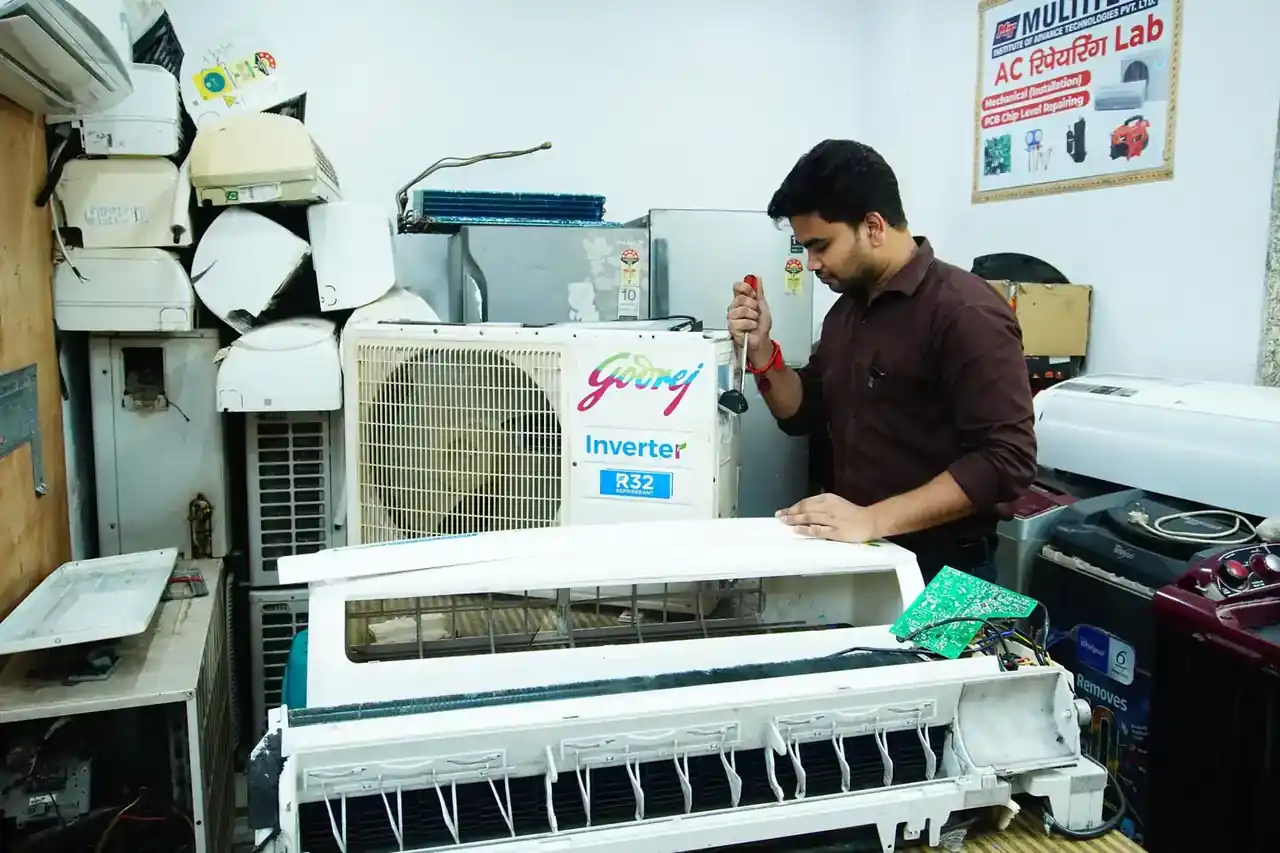
An air conditioner does not cool by magic: it works like a closed circuit in which each part pushes the next, from capturing heat to expelling it outside. In a home split system, the logic is easy to explain and harder to replace: the indoor unit takes air from the room, the refrigerant absorbs energy, and the outdoor unit releases that heat to the environment.
Behind that everyday act of lowering the temperature by a couple of degrees there is a precise system, with mechanical, electrical, and thermal components that must work together. Knowing its parts helps you understand performance, efficiency, and the most common breakdowns, from a saturated filter to a worn-out compressor or a blocked drain.
If you have a problem with your air conditioner, you can use our free error code search tool. From there, you can find out and solve all errors easily and effectively.
The basic architecture of a home split system
In most residential units, the system is divided into two visible blocks: the indoor unit, which lives inside the room, and the outdoor unit, installed on a facade, terrace, roof, or technical patio. Between them circulate the refrigerant, the electrical wiring, and the condensate drain, a small network of veins and tubes that keeps the unit alive.
The indoor unit is responsible for moving the room air through a cold coil, also called the evaporator. The outdoor unit, meanwhile, does the noisier and more demanding work: compressing the refrigerant, dissipating heat, and sustaining the cycle. The split works because both halves depend on each other; if one fails, the whole system loses capacity or stops.
In ducted, cassette, or multi-split installations, the underlying logic is the same, although the air distribution and construction complexity change. The heart of the process remains identical: compression, condensation, expansion, and evaporation. That thermal journey is what turns a sticky afternoon into a livable room.
What is inside the indoor unit
The indoor part is usually the most visible and the one the user touches every day, but it is also the most underestimated. Its mission is not just to blow cold air; it also filters particles, condenses moisture, and regulates airflow with a precision you can feel in the comfort level. Several parts work there almost silently.
The evaporator is the central piece. It is a coil of tubes and fins through which the refrigerant circulates at low pressure and low temperature. When the fan drives room air through those surfaces, heat passes from the air to the refrigerant. The result is cooler air returning to the room and refrigerant turning into vapor.
The indoor fan, also called a blower or turbine, moves that air in a very specific airflow pattern, aiming to distribute it without creating an uncomfortable blast. It does not cool by itself, but without it the evaporator would be a passive component. Its speed affects noise, thermal sensation, and how quickly the room reaches the chosen temperature.
The air filters perform a much more important job than they seem to. They trap dust, lint, pollen, and some airborne particles before they reach the evaporator. When they are dirty, the unit loses airflow, works harder, and can generate odors or frost. A clean filter means less strained breathing for the machine and for the home.
The condensate tray and the drainage system collect the water that forms when moisture in the air condenses on the cold coil. That invisible dripping may seem secondary, but it makes the difference between normal operation and an annoying leak on a wall or piece of furniture. If the drain gets blocked, the water will find its way out wherever it can.
There is also the electronic board, the control center that receives commands from the remote control, interprets sensors, and decides when to start or stop components. In modern units, this board communicates with temperature sensors, controls speeds, and adjusts the system’s behavior. It is a discreet part, but without it the unit would be a set of loose parts with no common logic.
The parts that run the outdoor unit
The outdoor unit concentrates the most demanding part of the work. There the unit raises refrigerant pressure, expels heat, and withstands weather, vibration, and dust. It is the block that consumes the most energy and also the one that suffers the most when ventilation is poor or maintenance has been neglected.
The compressor is the engine of the system. It sucks in refrigerant as a low-pressure gas, compresses it, and sends it at high pressure and high temperature through the rest of the circuit. That compression is the step that makes it possible for heat to travel outside the home. When a compressor ages or fails, the unit may turn on but not cool, or cool very poorly.
Then comes the condenser, a heat-exchange coil similar to a radiator. There the hot gas gives off heat to the outside air and changes from gas to liquid. The outdoor unit’s fan helps speed up that exchange, pulling air through the fins and preventing the system from becoming thermally overwhelmed on the hottest summer days.
The outdoor fan has a function as simple as it is decisive: move air so the condenser can release heat. If it turns poorly, if the motor loses strength, or if the blades are damaged, performance drops sharply. In many cases, the user first notices noise, vibration, or strange stops before realizing the unit no longer cools as before.
In heat pump units, the reversing valve or four-way valve changes the direction of the cycle and allows heating in winter. It is a part better known to technicians than to users, but its presence explains why many splits not only cool, but also heat. When it fails, the unit can get stuck in one mode or lose the ability to switch between cooling and heating.
Along with these elements, you will usually find the outdoor electronic board and various safety sensors, such as temperature probes or pressure switches, depending on the manufacturer’s design. These systems protect the compressor from abnormal pressures, overheating, and out-of-range conditions. They are the safety belt of the whole system.
The circuit that connects both halves
Between the indoor and outdoor units run the refrigerant pipes, usually made of copper and insulated to prevent thermal losses. One carries refrigerant in a high-pressure phase and the other returns the fluid in different conditions, depending on the point in the cycle. Without that connection, the indoor unit would have nothing to exchange heat with and the outdoor unit could not expel it.
That network also carries the refrigerant, a substance designed to change state easily. It is not just a liquid or a gas, but a thermal transport medium that absorbs heat when it evaporates and releases it when it condenses. That duality is why the system can turn hot air into pleasantly cool air.
The expansion valve, or the equivalent device depending on the model, reduces the refrigerant pressure before it enters the evaporator. This controlled throttling causes a sudden temperature drop and prepares the fluid to absorb heat in the indoor unit. It is a small transition in size, but enormous in impact.
Insulation also matters. A poorly insulated pipe loses efficiency, condenses moisture, or increases the unit’s effort. In long installations, especially in homes with complicated routes, the quality of the installation can make the difference between a system that performs well for years and one that starts showing early symptoms.
What each component does in the thermal cycle
The full sequence begins when the thermostat or the board detects that the room temperature is above the set value. Then the indoor fan draws air toward the evaporator and the cold refrigerant absorbs heat. The air returns cooler, while the refrigerant leaves as a gas heading to the compressor.
The compressor raises pressure and temperature, pushing that gas toward the condenser. There, the outside air and the fan release the accumulated heat. The refrigerant condenses and returns to a liquid state, ready to pass through expansion. That small closed circuit repeats again and again, like a mechanical breath expelling excess heat from the home.
The great virtue of this system is its continuity. It does not produce cold out of nowhere; it moves heat from one place to another. That idea, which seems simple, explains why maintaining filters, coils, and fans matters so much: any obstacle in the thermal path breaks the cycle’s flow and multiplies consumption.
Less visible parts that also matter
Beyond the main components, there are parts that often go unnoticed until they fail. The temperature sensor measures the air or the coil so the unit does not work too hard or fall short. If the reading is wrong, the air conditioner may shut off too early, keep running unnecessarily, or show erratic behavior.
The capacitor, or electrical condenser, in some designs, helps motors and compressors start. It is a small part, but when it ages the symptoms are usually clear: humming, difficulty starting, or cycles that stop unexpectedly. In current inverter units, electronics have replaced many older functions, although the underlying logic remains the same: start and regulate precisely.
Safety sensors and wiring are also part of the system. They protect against overloads, overheating, or communication failures between units. The user hardly sees them, but they are what keep the system from becoming a risky box when conditions worsen.
In larger installations, there may also be distribution boxes, more complex drains, or specific valves. In those cases, understanding the basic parts is still the first step to interpreting the rest of the system. Technology changes, but the thermal logic has not abandoned its original skeleton.
Which components get dirty, wear out, or cause the most trouble
Not all parts age the same way. The filters are the first to show the effects of heavy use, especially in homes with pets, dust, or frequently opened windows. When they are clogged, airflow drops and the blower has to work harder, like a person trying to run with a soaking wet scarf.
The evaporator and the condenser also get dirty over time. Dust and indoor grease build up on one; leaves, pollen, and environmental dirt on the other. When the fins are blocked, heat exchange worsens and performance drops. The unit may keep running, but its efficiency becomes sluggish and slow.
The drain is another sensitive point. A small blockage from biofilm, limescale, or dust can end up causing leaks, dripping, or moisture on the wall. Often the problem does not start with a major breakdown, but with a tiny layer of dirt that narrows the water passage until it is completely blocked.
The compressor is, by far, the most expensive part and one of the most heavily stressed. It works under constant pressure and its failure is usually serious. That is why, when a unit has trouble starting, makes unusual noises, or cannot stabilize the temperature, it is wise to check the whole system before immediately pointing to the most expensive component.
How to recognize a fault from its parts
Understanding the parts lets you read the symptoms more clearly. If the unit blows air but barely cools, the problem may be dirty filters, lack of refrigerant, a faulty expansion valve, or a compressor malfunction. If the appliance makes noise but the room does not improve, the thermal chain is interrupted somewhere.
When water appears on the wall or floor, the likely suspect is the drain, the condensate tray, or poor installation slope. If the unit stops on its own, the source may be sensors, the electronic board, or overtemperature protection. And if the outdoor unit vibrates excessively, you need to look at the fan, mounts, compressor, or even loose screws.
There are signs that also point to the electrical side. A compressor that does not start, a fan that stops irregularly, or a unit that responds late to the remote control often point to the electronics, the capacitor, or the communication between boards. A fault rarely appears in isolation; it almost always leaves a chain of symptoms that, when read properly, narrows down the problem.
That is why knowing how to name the parts is not just a catalog exercise. It helps you talk to a technician, understand a quote, and avoid rushed diagnoses. Anyone who can distinguish between evaporator, compressor, and condenser no longer sees the machine as an opaque box, but as a legible mechanism.
Why maintenance depends on understanding the unit’s structure
Periodic filter cleaning, drain inspection, and visual checks of the outdoor unit are not ornamental tasks. They protect efficiency, reduce consumption, and extend service life. A clean unit needs less effort to achieve the same thermal sensation, just as an engine breathes better when it is not dragging mud.
In addition, knowing the parts of the air conditioner allows you to detect when performance starts to deteriorate, before the fault becomes obvious. A small change in sound, a temperature fluctuation, or an isolated drip can be the first clue of a bigger problem. The machine, like so many household systems, warns you before it breaks down completely.
In hot climates and with heavy use, that early reading saves money and avoids discomfort. A dirty filter may seem minor, but behind it there could be a frozen evaporator, an overworked compressor, or a higher-than-normal electricity bill. Efficiency always starts with the basics: clean air, free exchange, and balanced components.
The hidden logic behind a machine that seems simple
Modern air conditioning is a piece of everyday engineering: discreet, almost domestic, but governed by an exact sequence of thermal movements. Each component has its role and its moment. The compressor pushes, the condenser releases, the expansion prepares, and the evaporator absorbs. Between them, fans, sensors, filters, and boards keep the process stable and safe.
That is why talking about the parts of an air conditioner also means talking about its real behavior: why it cools more slowly on some days, why water appears, why a new noise deserves attention, or why an outdoor unit can make the difference between comfort and frustration. The machine does not just move air; it organizes an energy exchange that, when properly understood, reveals both its strengths and its limits.
That knowledge is useful for any user, even without technical training. It allows you to look at the unit with judgment, recognize which part is behind a symptom, and understand that home cooling does not depend on a single block, but on a precise choreography. When one part fails, the whole system feels it; when everything works well, the result seems simple, even though inside it is anything but.
Este artículo contiene enlaces de afiliado: si compras a través de ellos, se genera una pequeña comisión sin coste adicional para ti. Más información.


Balay hob error: causes and safe solutions

E18 error in Balay washing machine: drain causes and fix

Balay washing machine F4 error: how to restore drainage

Error in a 2013 Balay A++ refrigerator: causes and fixes

Balay induction hob error 22: how to fix it

E17 error in the Balay 3TS60107 washer: causes and fix

Balay washing machine E93 error: causes and safe solution
E9 error on a Balay induction hob: causes and solution
E9 error on a Balay induction hob: causes and solution

Balay E9 error on a freezer: causes and solution

 Balay6 days ago
E05-32 error on a Balay oven: causes and safe solution
- Washing machine6 days ago
Hotpoint washing machine F09 error: what it means and what to do
- Balay5 days ago
E09 error in Balay dishwasher: causes and safe solution
- Dishwasher5 days ago
E15 error on Balay dishwasher: do not tilt it
- Dishwasher6 days ago
E09 error in Balay dishwashers: causes and safe solution
- Balay5 days ago
Balay washing machine E12 error: causes and safe solution
- Dishwasher5 days ago
Balay dishwasher E15 error: warranty coverage and solution
- Balay6 days ago
E0 error on a Balay induction hob: causes and fixes
- Dishwasher5 days ago
E11 error in Balay dishwashers: causes and solutions
- Balay4 days ago
Balay washing machine E2 error: causes and safe solutions
- Balay6 days ago
E09 error in Balay dishwasher 3VS503IA: causes and fix
- Dishwasher5 days ago
Balay dishwasher E16 error: causes and safe solution