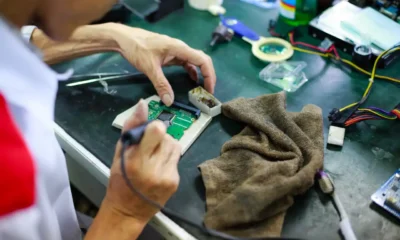
Drying machine
E71 error on an Electrolux dryer: causes and useful solution
The warning usually indicates a fault in the temperature probe and requires checking connections, resistance, and diagnostics.

E71 error on an Electrolux dryer: causes, signs, and useful solutions
The E71 error on an Electrolux dryer usually indicates a fault in the NTC probe, the sensor that measures temperature so the appliance knows when to heat, when to cut off, and how to maintain stable drying. The warning appears when the electronics lose confidence in the temperature reference and detect that the thermal circuit is providing an abnormal or unreliable reading.
When that reading is wrong, the dryer loses thermal balance. It may stop in the middle of a program, dry unevenly, take much longer than usual, shut off early, or display a preventive alarm. The clothes may remain damp in some areas, feel cold, or appear to have been dried in bursts rather than through a stable cycle.
In practice, the problem is not always in the NTC sensor itself. It can also involve a loose or partly disconnected connector, corroded terminals, damaged cables, an open connection, a short circuit, a defective heating element, a bad contact in its circuit, or an incorrect reading from the electronic board. That is why it is important to check the whole assembly instead of replacing the sensor immediately. A dryer is a network of small signals that works like a traffic light: if one of the signals fails, the rest gets out of sync.
If you have a problem with your dryer, you can use our free error code finder. From there you can easily identify the meaning of different errors and find practical information to help solve them.
What the E71 warning really means
An Electrolux dryer continuously monitors its internal temperature. That information allows the appliance to decide when to activate the heating system, when to cut it off, and how to distribute heat during the drying cycle. The NTC sensor performs an essential function in this process: it changes its electrical resistance as the temperature rises or falls and translates that change into a signal that the control board can interpret.
NTC stands for negative temperature coefficient thermistor. In simple terms, it is a component whose resistance varies according to temperature. The system may look straightforward, but it is crucial. Without an accurate reading, clothes may come out damp because there is not enough heat, or they may be exposed to excessive heat because the appliance cannot regulate the cycle correctly.
When E71 appears, the electronics determine that the information received from the sensor does not match the expected values. The sensor does not have to be completely broken for this to happen. An out-of-range reading, an intermittent signal, an open connection, a short circuit, or a value that disappears from time to time can be enough to trigger the alarm.
The appliance is not guessing. It is reacting to a technical inconsistency that affects both performance and safety. The dryer behaves as if it has lost one of its basic references and therefore cannot continue controlling heat with sufficient confidence.
In condenser and heat pump models, thermal monitoring can be even more sensitive. The dryer depends on a stable temperature reading to regulate hot air, manage moisture, protect internal components, and maintain efficiency. A brief deviation may be enough for the control system to block the program and leave the E71 code visible on the display.
A dryer without a reliable temperature reference is like a clock with a missing hand: it can still move, but it no longer keeps time properly. In this case, it can still start or run for part of a cycle, but it cannot guarantee that the temperature is being managed correctly.
| Code | Description | Possible causes | What to check | What it affects |
|---|---|---|---|---|
| E71 | Problem with the NTC sensor or abnormal temperature reading | Faulty sensor, open connection, short circuit, damaged wiring, loose or corroded connector, defective heating element, bad contact, or incorrect circuit reading | NTC sensor, connectors, wiring harness, heating element, ventilation, and electronic board | Heat control, cycle duration, drying quality, appliance protection, and drying safety |
The most common causes behind the E71 fault
Faulty or deteriorated NTC sensor
The most frequent cause is a faulty NTC sensor. With prolonged use, humidity, vibration, and repeated temperature changes, the component can deteriorate and begin to provide inconsistent values.
Sometimes the sensor fails continuously. In other cases, it works when the dryer is cold and starts giving an incorrect reading only after the appliance has been running for a while and the heat brings the problem to light. This type of intermittent fault can be especially difficult to identify because the dryer may appear to work normally during a short test.
A sensor can also become unreliable without showing visible physical damage. It may report a value that is technically possible but outside the range expected by the control system. That is enough for the electronics to interpret the signal as unsafe or abnormal.
Loose, corroded, or damaged connections
It is also common to find corroded connectors, loose terminals, or poorly seated plugs. Heat, moisture, vibration, and condensation gradually affect electrical contacts inside a dryer. A connector that is only partly disconnected can cause more trouble than an obvious broken wire.
Wiring may be damaged by heat, internal rubbing, vibration, or repeated movement of the harness. A cable can look intact from the outside while being damaged internally. Likewise, a terminal may appear connected but lose contact when the appliance warms up or when the harness moves during operation.
At first glance, these faults may seem insignificant. However, the NTC signal is sensitive, and a small variation in contact quality can alter the value received by the electronic board. A loose connection can therefore imitate a defective sensor.
Heating element or heating circuit fault
The heating element and its surrounding thermal circuit must also be considered. If the element has abnormal electrical values, a bad contact, or an insulation fault, it may confuse the thermal reading or cause the control system to associate the problem with the NTC sensor.
The heating element does not always fail completely. It may begin with vague symptoms such as uneven heating, clothes that remain cold, excessively long cycles, or a dryer that works correctly only for part of the program. The system may eventually cut off for safety and display E71. In that situation, the code is not necessarily the entire breakdown; it may be the warning that reveals a related problem in the heating assembly.
Moisture, lint, and poor thermal conditions
Accumulated moisture inside the appliance, lint trapped in sensitive areas, or restricted airflow can affect the thermal environment. Poor ventilation forces the dryer to work under greater stress and can alter the behavior of the whole system, even when the NTC sensor itself is healthy.
Lint is not merely dirt in this context. It can act as unintended thermal insulation, interfere with heat dissipation, restrict airflow, and increase the load on the heating and ventilation systems. The dryer breathes, heats, and exhausts air, so the conditions around the sensor influence the way its signal is interpreted.
Incorrect previous repair or electronic reading fault
A poorly handled previous repair, a badly adjusted connection, or an incorrectly assembled component can also leave consequences. The electronics do not distinguish perfectly between a damaged part and an environment that makes that part appear damaged: it responds to the complete circuit.
If the sensor, wiring, connectors, and heating element are all behaving correctly, the fault may be located in the electronic board or in the circuit that feeds and interprets the NTC signal. A board can misread a correct signal, although this possibility should generally be checked after the simpler causes have been investigated.
How the E71 error appears in everyday use
The clearest symptom is the E71 message on the display, but it does not always arrive alone. The dryer may show one or several of the following behaviors:
- The program stops halfway through the cycle.
- The appliance starts normally and then shuts off abruptly.
- The dryer stops early as soon as the temperature reading becomes unreliable.
- The cycle takes much longer than usual.
- The appliance dries poorly or does not produce enough heat.
- Clothes remain damp in certain areas while other parts are drier.
- The garments feel cold or do not reach the expected level of dryness.
- Heating appears irregular, as if the drum were working in bursts.
- The dryer operates normally for a short time and then displays the error when it becomes hot.
- The machine starts and stops unexpectedly.
- Energy consumption increases without any improvement in drying performance.
In some cases, the appliance does not stop immediately. It may complete part of the cycle while providing a poor result. Clothes can remain damp, cycles can become excessively long, and the user may need to repeat the program. This behavior indicates that temperature control has lost precision, even if the fault does not initially seem dramatic.
When the thermal reading is unreliable, the dryer enters a kind of automatic caution mode. Before risking overheating or ineffective drying, the electronics protect the appliance and block the process. The issue is therefore not necessarily the selected program or the laundry load; it may be the information that the electronic board receives to control heat.
What E71 can affect beyond the sensor
Poorly controlled heat affects more than the immediate drying result. The heating element may wear out sooner, the fan may be placed under additional strain, and the dryer may consume more electricity while delivering less useful work.
The clothes can also pay the price. Uneven drying leaves garments damp, prolongs their exposure to heat, and may force several cycles to be repeated. Repeated or poorly controlled heating can affect fabrics, seams, and delicate materials. A code that appears to be only an annoying message can therefore lead to higher energy consumption, poorer laundry results, and additional wear on the appliance.
For this reason, E71 protects the machine as much as it inconveniences the user. Heat control is not designed to guess. It prevents the temperature from rising too far or remaining too low. If the reference fails, the dryer loses one of its main safety controls.
What to check before assuming a major breakdown
The first sensible step is to unplug the dryer from the power supply. Inspecting the sensor, connectors, and related components must always be done with the appliance de-energized. A dryer contains electrical and heating components, so safety should take priority over speed.
1. Inspect the NTC sensor and its connections
With the dryer disconnected, check the accessible area around the NTC sensor and its connectors. Look for:
- Loose terminals or a plug that is not fully seated.
- Oxidation or corrosion on electrical contacts.
- Wiring damaged by heat or internal rubbing.
- Visible cuts, pinched sections, or signs of deterioration.
- A harness that moves excessively or appears incorrectly positioned.
- Evidence of a previous repair that was not correctly assembled.
There is no need to find spectacular damage. Many E71 faults begin with small, almost invisible details. A clean and orderly visual inspection can already reveal a poor connection or a damaged cable.
2. Check the ventilation area and lint filters
Check that the lint filter is clean and that the ventilation area and ducts are not obstructed. Also consider whether the appliance has been operated with the filter in poor condition or with restricted airflow.
Although E71 directly points to thermal control, poor airflow can alter the behavior of the complete system. The dryer must be able to move and release air correctly. Excess lint and inadequate ventilation can increase thermal stress and push the appliance toward erratic readings.
Cleaning the lint filter, clearing the appropriate ducts, or emptying the condensate tank may improve general performance, but these actions do not automatically repair a genuine E71 fault. They are maintenance measures, not a structural cure for a defective sensor, damaged harness, faulty heating element, or electronic problem.
3. Test the NTC sensor with a multimeter
If you have the necessary technical knowledge, measuring the NTC sensor with a multimeter can help determine whether it responds within a logical range for the temperature. The reading should change consistently as the sensor temperature changes.
An infinite reading, a zero reading, or a clearly inconsistent value usually confirms a sensor or connection fault. A sensor that behaves correctly at room temperature should not automatically be considered free of problems, because some faults appear only once the dryer has heated up.
For that reason, a technician may need to compare the circuit when it is cold and when it is hot. A sensor can provide a plausible reading at room temperature and then fail after the appliance has been running for a while. This is one reason intermittent E71 faults can return after a short cycle.
4. Check the wiring, heating element, and electronic board
If the NTC sensor responds correctly, attention should shift to the wiring harness, connectors, heating element, and electronic board. The sensor may be healthy while its signal is being interrupted or incorrectly interpreted elsewhere in the circuit.
A technician can also check whether the fault appears when the cable harness is moved. If E71 appears or disappears when the wiring is gently repositioned during a controlled diagnostic test, that may indicate an intermittent contact or internal cable break.
The heating element should be investigated when there are signs of uneven heating, cold clothes, abnormally long cycles, or a bad contact in the heating circuit. Only after these checks should the electronic board become the main suspect. Replacing parts without following this order can make the repair more expensive and leave the original fault unresolved.
Why it is not a good idea to force the appliance to continue working
Continuing to use the dryer while E71 remains active can worsen the problem. Each additional cycle adds thermal and electrical load to components that may already be operating outside their normal limits. What begins as a reading fault can become a broader breakdown affecting the heating element, wiring, board, or other nearby components.
There is also a clear safety aspect. The heating element and temperature-control system are not designed to operate blindly. If the NTC signal fails, the electronics no longer have a reliable reference and must shut down or interrupt the service before the situation becomes more serious.
Forcing the dryer to continue breaks that protective logic and exposes the appliance to unnecessary wear. It may also produce higher-than-necessary energy consumption without delivering better drying.
The laundry can suffer as well. An uneven drying process leaves garments damp, prolongs their exposure to heat, and forces cycles to be repeated. That uses more energy and may damage fabrics and seams. The E71 warning is therefore not merely an inconvenient display message; it is a sign that the internal drying balance has been disturbed.
When it makes sense to call a technician
If the visual inspection does not clarify the cause, or if the sensor, connectors, wiring, and heating element appear to be correct, the sensible step is to request a specialized inspection.
A technician can:
- Measure the NTC sensor and its circuit with the proper instruments.
- Compare the reading when the appliance is cold and when it is hot.
- Check whether the fault appears only after the dryer has been running for a while.
- Inspect whether moving the wiring harness causes the signal to change.
- Test the heating element and its electrical contacts.
- Distinguish between a defective component and a correct component being misread by the electronics.
- Determine whether the fault is located in the sensor, wiring harness, connector, heating assembly, or electronic board.
The advantage of a professional diagnosis is that it avoids unnecessary replacements. Replacing an NTC sensor when the real problem is a connector solves nothing. Changing the heating element when the sensor is functioning correctly only adds cost and wasted time. Likewise, replacing a board before checking the wiring can prolong the fault rather than solve it.
In these appliances, the order of the checks matters just as much as the final part that is replaced. An exact reading is worth more than a rushed replacement.
When E71 reappears after resets or returns after a short cycle, the message is clear: there is probably a real anomaly in the temperature circuit. In that situation, technical intervention stops being merely a cautious option and becomes the most efficient and safest path.
Resetting the dryer does not necessarily repair E71
A reset may temporarily clear the display or allow the dryer to start again, but it does not repair a defective sensor, damaged cable, loose terminal, faulty heating element, or electronic reading problem.
If the code returns after a reset, after a short program, or once the appliance reaches operating temperature, the underlying fault remains. Repeated resets should not be used as a substitute for checking the thermal circuit. They may only postpone the moment when the dryer stops again.
A recurring code is particularly important because it suggests that the electronics are repeatedly detecting the same abnormal condition. That pattern should not be ignored, even if the dryer occasionally completes a cycle.
A small fault with visible effects throughout the laundry
The value of a well-adjusted dryer lies in its apparent simplicity: wet clothes go in and ready clothes come out. Behind that routine, however, there is a continuous dialogue between the NTC sensor, heating element, ventilation system, moisture conditions, and electronic control.
E71 breaks that dialogue at the most delicate part of the process. The appliance no longer has a reliable heat reference, so it may stop, extend the program, dry unevenly, or protect itself by shutting down.
That is why the code deserves immediate attention. It is not usually a random fault or an isolated alarm. It is generally the trace of a real problem somewhere in the temperature chain. Identifying the cause in time helps prevent inefficient drying, unexpected stops, repeated programs, and secondary damage to components that may still be working but are being forced to operate with an incorrect signal.
An Electrolux dryer with a healthy thermal sensor works with clock-like precision. When E71 appears, that clock loses a hand. In an appliance that depends on timing, heat, airflow, and balance, one hand out of place is enough to alter the whole mechanism.
What this error reveals about dryer maintenance
E71 is also a reminder that preventive maintenance is not a minor ritual. Keeping filters clean, ducts clear, and ventilation correct helps the electronics work under less stress. These actions do not eliminate an electronic fault on their own, but they reduce the thermal strain that can contribute to abnormal readings and premature wear.
It is worth monitoring the laundry load and respecting the appliance’s intended use. Overloading the drum restricts airflow, forces longer cycles, increases demands on the thermal system, and leaves the dryer with less operating margin. Continuous excess strain can affect the NTC sensor, heating element, fan, and electronic board.
The load can therefore contribute indirectly to the conditions in which E71 appears. The dryer may continue working, but it is no longer operating at its optimum point. Over time, that stress takes its toll on the complete assembly.
Moisture, lint, heat, and wiring form a network that ages together. When one part begins to fail, another may suffer or appear to be the source of the problem. The E71 code may point directly toward the NTC sensor, but accurate diagnosis requires looking at the dryer as a system rather than as a collection of isolated parts.
How to approach an E71 diagnosis
The most reliable approach is to proceed from the simplest checks to the most complex ones:
- Disconnect the dryer from the power supply.
- Inspect the NTC sensor area and its connections.
- Look for corrosion, loose terminals, damaged cables, and signs of a poor previous repair.
- Clean the lint filter and check ventilation and airflow conditions.
- Measure the NTC sensor with a multimeter if you have the appropriate technical knowledge.
- Consider that an intermittent sensor fault may appear only when the dryer is hot.
- If the sensor is correct, inspect the wiring harness and check for changes when the harness is moved during a controlled test.
- Test the heating element and its contacts if heating is uneven, insufficient, or abnormally prolonged.
- Investigate the electronic board only after the sensor, connections, wiring, and heating element have been checked.
- Call a qualified technician if the code remains, returns after a reset, or reappears after a short cycle.
This sequence helps prevent unnecessary part replacement. The goal is not to change the first component associated with the code, but to determine accurately whether the source is the sensor, its installation, the surrounding thermal circuit, or the board that interprets the signal.
When temperature is no longer reliable
The E71 warning sums up a specific idea: the dryer has lost confidence in the temperature information it receives. That loss of confidence can originate in the NTC sensor, a loose or corroded connector, a worn terminal, an open connection, a damaged cable, a defective heating element, a bad contact, or the electronic circuit that interprets the signal.
The visible symptom is the code, but the real problem lies in the chain that allows heat to be measured and controlled. That is why the same warning can be accompanied by different behaviors, including repeated stops, long cycles, cold clothes, uneven drying, higher consumption, or a fault that appears only once the appliance becomes hot.
Dealing with E71 promptly helps avoid inefficient drying, repeated stops, damage to fabrics, and secondary failures that make the repair more expensive. An Electrolux dryer with accurately measured temperature protects both the clothes and its own components. When that reference breaks down, the appliance makes it clear.
In the end, temperature is the dryer’s internal language, and the NTC sensor is the component that translates it. If that translation fails, the machine protects itself, the cycle is interrupted, and the user sees a number on the display where normal operation used to be. Understanding the warning makes it possible to act with judgment and prevent a reading fault from becoming a larger breakdown.
Este artículo contiene enlaces de afiliado: si compras a través de ellos, se genera una pequeña comisión sin coste adicional para ti. Más información.


Balay hob error: causes and safe solutions

E18 error in Balay washing machine: drain causes and fix

Balay washing machine F4 error: how to restore drainage

Error in a 2013 Balay A++ refrigerator: causes and fixes

Balay induction hob error 22: how to fix it

E17 error in the Balay 3TS60107 washer: causes and fix

Balay washing machine E93 error: causes and safe solution
E9 error on a Balay induction hob: causes and solution
E9 error on a Balay induction hob: causes and solution

Balay E9 error on a freezer: causes and solution

 Balay7 days ago
E05-32 error on a Balay oven: causes and safe solution
- Washing machine6 days ago
Hotpoint washing machine F09 error: what it means and what to do
- Balay6 days ago
E09 error in Balay dishwasher: causes and safe solution
- Dishwasher6 days ago
E15 error on Balay dishwasher: do not tilt it
- Dishwasher6 days ago
E09 error in Balay dishwashers: causes and safe solution
- Dishwasher5 days ago
Balay dishwasher E15 error: warranty coverage and solution
- Balay6 days ago
Balay washing machine E12 error: causes and safe solution
- Dishwasher6 days ago
E11 error in Balay dishwashers: causes and solutions
- Balay5 days ago
Balay washing machine E2 error: causes and safe solutions
- Balay6 days ago
E09 error in Balay dishwasher 3VS503IA: causes and fix
- Dishwasher5 days ago
Balay dishwasher E16 error: causes and safe solution
- Balay7 days ago
E0 error on a Balay induction hob: causes and fixes