Magazine
Air fryer containers: which to use and which to avoid
Glass, silicone, steel, or paper: safe materials, useful sizes, and mistakes to avoid.

The choice of air fryer-compatible containers makes the difference between a golden dinner and an appliance punished by misuse. The material, shape, and size influence both air circulation and the final result: a crispy base, a fluffy cake, or vegetables that don’t dry out too soon.
Not everything goes in this area. The most practical options are usually food-grade silicone, tempered glass, oven-safe ceramic, stainless steel, and perforated parchment paper. Plastic, wood, cardboard, or poorly used aluminum, on the other hand, can warp, block heat flow, or even create unnecessary risks.
If you have a problem with your air fryer, you can use our free error code finder. From there you can identify and solve all errors easily and effectively.
What makes a container suitable for an air fryer
The key is not just whether the container can withstand heat. An air fryer works like a small thermal whirlwind: hot air spins at high speed and needs space to surround the food on all sides. If the pan takes up too much room, browning becomes uneven; if it is too light, it can move with the airflow; if it is unstable, it ends up being more of an obstacle than a help.
The first rule is fit. The container should slide in without forcing, leave room around it, and not completely cover the base of the basket. The second is heat resistance. Although many accessories are advertised as suitable for high temperatures, it is worth checking that they can withstand at least between 200 and 230 °C, which is a common range in this type of appliance. In some steel or glass accessories, tolerance goes even higher, even to 260 °C or more, but the manufacturer’s specifications still matter most.
The surface also matters. Designs with ridges, perforations, or raised bases help fat drain away and allow air underneath the food. It’s a small detail, but you can notice it in drier potatoes, better-sealed wings, and breading that is less dense. When the bottom is smooth and the container is very deep, the cooking is more like a closed oven than an air fryer; it still works, yes, but the result changes.
The materials that perform best in real use
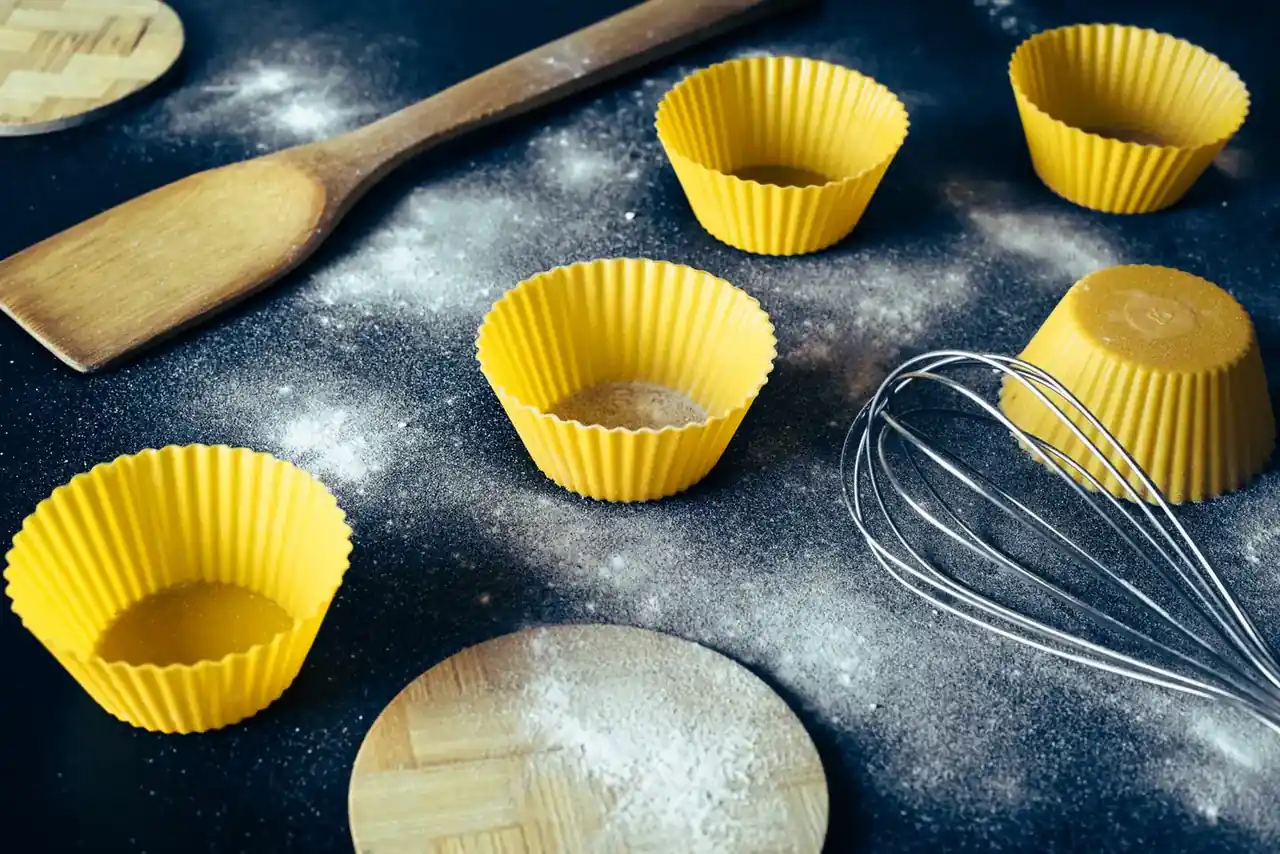
Food-grade silicone has earned a central place because it combines flexibility, easy release, and quick cleaning. Square or round molds are especially useful for savory tarts, baked eggs, muffins, quiches, and small cakes. They usually withstand up to 220 or 230 °C and, in many cases, can be washed in the dishwasher. In addition, they fold, take up little space, and hold up well to repeated use.
Tempered glass and borosilicate offer another advantage: they let you see how the food is cooking without opening the basket. They are useful for gratins, cannelloni, baked fish, moist desserts, and recipes with sauce. Their behavior is especially good for preparations that need a stable container and a clean presentation for serving directly at the table. That said, glass requires caution with sudden temperature changes; a thermal shock can crack or break it.
Oven-safe ceramic works in a similar way, with heat retention that is highly valued in dishes served hot and meant to stay that way for a few minutes. Ceramic casseroles are a good option for roasted vegetables, puddings, small stews, or cheesy gratins. They are heavier than silicone and, precisely for that reason, move less with the airflow. Their limit is weight and the fact that they must be pieces without metal decorations or questionable glazes.
Stainless steel stands out for its durability and the way it distributes heat. It is ideal for trays, racks, and multi-level accessories, especially when you want to cook more than one preparation at a time. It is also practical for skewers, small pastries, or meat and vegetable pieces that need a sturdy base. In everyday cooking, it has a very clear advantage: it withstands heavy use without warping and does not absorb odors.
Parchment paper, when used sensibly, remains one of the most practical resources. Perforated formats let air pass through and prevent delicate or breaded foods from sticking. They are useful for breaded items, fish, croquettes, or chopped vegetables. They also make cleanup much easier when working with marinades or sticky mixtures. The key is to always use it with food on top; its lightness works against it if left loose inside a hot air fryer.
Containers that are best left out
Plastic is not a safe bet, even if it can withstand microwaves or cold. Air fryers work at harsher temperatures and with a strong air current, so a plastic container may warp, lose its shape, or release unwanted compounds. The problem is not just aesthetic: a softened piece can touch the heating element or drip onto the basket.
Wood and bamboo are also poor candidates. They work well in other cooking contexts, but dry, direct heat can dry them out, crack them, or even burn them. Something similar happens with ordinary cardboard, napkins, or papers not designed for cooking. An apparently harmless material then becomes a thin wick inside a very hot cavity.
Improperly placed aluminum deserves a nuance. Strong aluminum pans can be used in many recipes, but loose aluminum foil is not the same as a safe mold. If it covers too much surface, it hinders air circulation; if it flies around or shifts, it can rub against internal components. The difference between correct use and problematic use is huge, and in this appliance you notice it immediately in the cooking and in the cleanup afterward.
It is also wise to distrust containers with metallic decorations, rubber handles, or soft parts not designed for intense heat. A plastic handle may last a few minutes in a conventional oven and fail sooner in the air fryer because of its proximity to the heating element. In these appliances, the smallest details count as if they were safety edges.
Which format works best depending on the recipe
There is no single ideal container, because the air fryer does not always cook the same thing. For baking, silicone or enameled steel molds are especially practical. Small cakes, cupcakes, muffins, and tartlets need sides that keep their shape without sticking or unmolding roughly. Silicone wins for ease; enameled steel, for sturdiness.
For savory dishes with sauce, such as cannelloni, fish with a vegetable base, or small lasagnas, a glass or ceramic container gives better results than an open basket. It retains heat, distributes temperature well, and lets you serve without changing dishes. That continuity between cooking and presentation is useful in simple meals, where the container also serves as tableware.
For preparations that aim for a dry, crispy texture, such as potatoes, nuggets, croquettes, or breaded vegetables, a perforated base or elevated rack works best. The more contact the air has with the food, the more even the browning will be. Here, perforated silicone mats and mesh baskets have an advantage over closed molds, which tend to trap steam and soften the crust.
Multi-level accessories, on the other hand, open up a different logic: cooking in height. A high stainless-steel rack can be used to roast more food in a single batch or to separate ingredients that should not touch. In a small home kitchen, that stacking capacity is almost as valuable as the appliance’s speed itself.
What to check before buying an accessory
Compatibility is not measured only by liters. A 5.5-liter model and a 6-liter model can have baskets with different shapes, and that completely changes the fit. Square air fryers make better use of rectangular or square molds; round ones work better with circular containers. An accessory that looks excellent in a catalog can end up useless if it does not allow air to circulate or if it touches the side walls.
Internal measurements matter more than nominal capacity. A 21-centimeter mold may be roomy in a large basket and fit like a puzzle piece in another. Height also matters. If the container is too tall, the food ends up too close to the upper heating element and browns on top before it cooks through. The ideal is always to leave a visible safety margin, not to push things to the millimeter.
Ease of cleaning is another decisive factor. Foldable silicone, dishwasher-safe enameled molds, and disposable parchment paper reduce washing time. By contrast, a steel rack with many slots may offer better cooking, but it requires more patience afterward. In day-to-day use, that difference matters as much as the initial price of the accessory.
There is also a stability criterion. Too-light accessories shift; too-flexible ones bend when removing hot food; heavy ones need a firm grip to avoid burns. The best pieces combine sturdiness, wide handles, and safe edges. It is no coincidence that many of the highest-rated models on the market emphasize precisely those three characteristics.
Accessories that have gained ground in home kitchens
Reusable silicone molds have become the most visible accessory for a simple reason: they solve the maintenance problem without requiring a learning curve. They work like an auxiliary tray inside the air fryer and, in many cases, can be placed directly in the oven or microwave. That explains why they appear in so many homes as a substitute for disposable paper.
Air fryer parchment paper has gained momentum for another reason: cleaning. In a kitchen where you prepare marinated wings, marinated salmon, or vegetables with oil, the tray ends up with sticky residue that is very hard to remove. A disposable liner avoids that punishment, although it should not be used as if it were a magic tray. It still needs weight on top and some care so it does not touch the upper part of the appliance.
Glass baskets and molds have also moved up because they fit a more home-oriented and less improvised use. They are suitable for small portions, oven-style preparations, and recipes that go straight to the table without being transferred. Compared with purely technical accessories, they have a nearly silent virtue: they do not require the cook to adapt the recipe to the mold, but rather let the mold accompany the recipe.
At the most functional end are racks and rotisserie skewers. They are less eye-catching, but they open up specific possibilities: browning on all sides, cooking small pieces without crowding them, and using heat more precisely. For those who use the air fryer often, these accessories change the appliance’s logic and bring it closer to a small, well-tuned convection oven.
Common mistakes that ruin the result
One of the most common mistakes is overfilling the container. If the food rises to the edge, air stops circulating freely and cooking becomes uneven. The result can be one browned side and another soft one, as if the dish had gone through two different kitchens. Leaving 1 or 2 centimeters of space at the top is usually a sensible measure.
Another common mistake is thinking that any oven-safe container works the same in an air fryer. That is not always the case. A mold may withstand the static heat of an oven and yet perform poorly in a smaller compartment with intense air circulation. That is why it is worth looking not only at the maximum temperature, but also at the shape of the accessory and how it lets heat flow through.
People also tend to overlook pre-cleaning. Old grease, flour residue, or a poorly washed coating generate smoke, odors, and, in some cases, a stickier surface. Air fryers do not forgive old crusts very well; whatever is left stuck on ends up carbonizing, and that smoke alters the flavor of everything else.
Finally, there is overconfidence in small or improvised pieces. A loose rack, a poorly cut sheet of paper, or a mold with questionable edges may seem minor, but in a machine where air pushes hard every second, details end up in the food. Safety here is almost a matter of geometry.
How to choose without overcomplicating things and get it right more often
The most balanced choice usually involves combining three families of accessories: silicone for soft recipes or easy release, glass or ceramic for moist and gratin-style preparations, and stainless steel or racks for dishes that need more air circulation. With that base, most home recipes are covered without filling the kitchen with unnecessary utensils.
Perforated parchment paper adds a quick solution for sticky or very greasy recipes. And, if the appliance is used a lot, a well-chosen kit can be more useful than individual pieces bought on impulse. Not by quantity, but by coherence: that they fit together, match the basket’s actual size, and respond to what is really cooked at home.
In the end, the best air fryer containers are not the flashiest or the ones with the most functions on the box. They are the ones that respect circulation space, withstand heat without deteriorating, and simplify everyday cooking without making it clumsy. On a countertop full of hurry, that balance is worth more than any eye-catching accessory.
The air fryer performs best when the container acts as an ally and not as a stopper. A well-chosen mold lets air pass through, supports the food, and keeps the appliance clean; the wrong one turns a promising cook into something soft, uneven, or hard to serve. That is the real difference between cooking with judgment and merely turning on an appliance.
Este artículo contiene enlaces de afiliado: si compras a través de ellos, se genera una pequeña comisión sin coste adicional para ti. Más información.


Balay washing machine E80 error: meaning and what to do

E80 Error in Balay Ovens: Safe Causes and Solutions

E63 error on a Balay dryer: causes and safe solutions
E63 error on a Balay washing machine: causes and safe fixes

Balay washing machine E61 error: meaning and what to do

E61 error on a Balay washing machine: meaning and action

E6 PUNP error on a Balay washing machine: meaning and next steps

E56 error on Balay dryer: causes and safe solutions

E56 error on Balay washing machines: meaning and safe solutions

E50 error on Balay dryers: causes and safe solution

 Kitchen plate6 days ago
E Error on Balay Series 900 Hob: Causes and Solutions
- Dishwasher6 days ago
E25 error in Balay dishwasher: causes and solutions
- Balay6 days ago
E16 Error on a Balay Washing Machine: Causes and Safe Fixes
- Kitchen plate6 days ago
Balay induction hob E error: causes and solutions
- Balay6 days ago
E21 error in Balay dishwashers: causes and solutions
- Balay4 days ago
E09 error in Balay dishwasher: causes and safe solution
- Balay5 days ago
E05-32 error on a Balay oven: causes and safe solution
- Washing machine5 days ago
Hotpoint washing machine F09 error: what it means and what to do
- Balay6 days ago
Balay washing machine E18 error: causes and safe fix
- Balay6 days ago
E61 error on a Balay washing machine: causes and safe fix
- Balay6 days ago
Error E on a Balay hob: what it means and what to do
- Dishwasher4 days ago
E09 error in Balay dishwashers: causes and safe solution