Samsung
3C error on Samsung washing machine: causes, inspection, and solution
The 3C warning indicates a fault in the drum rotation and requires checking the motor, load, and electronics.

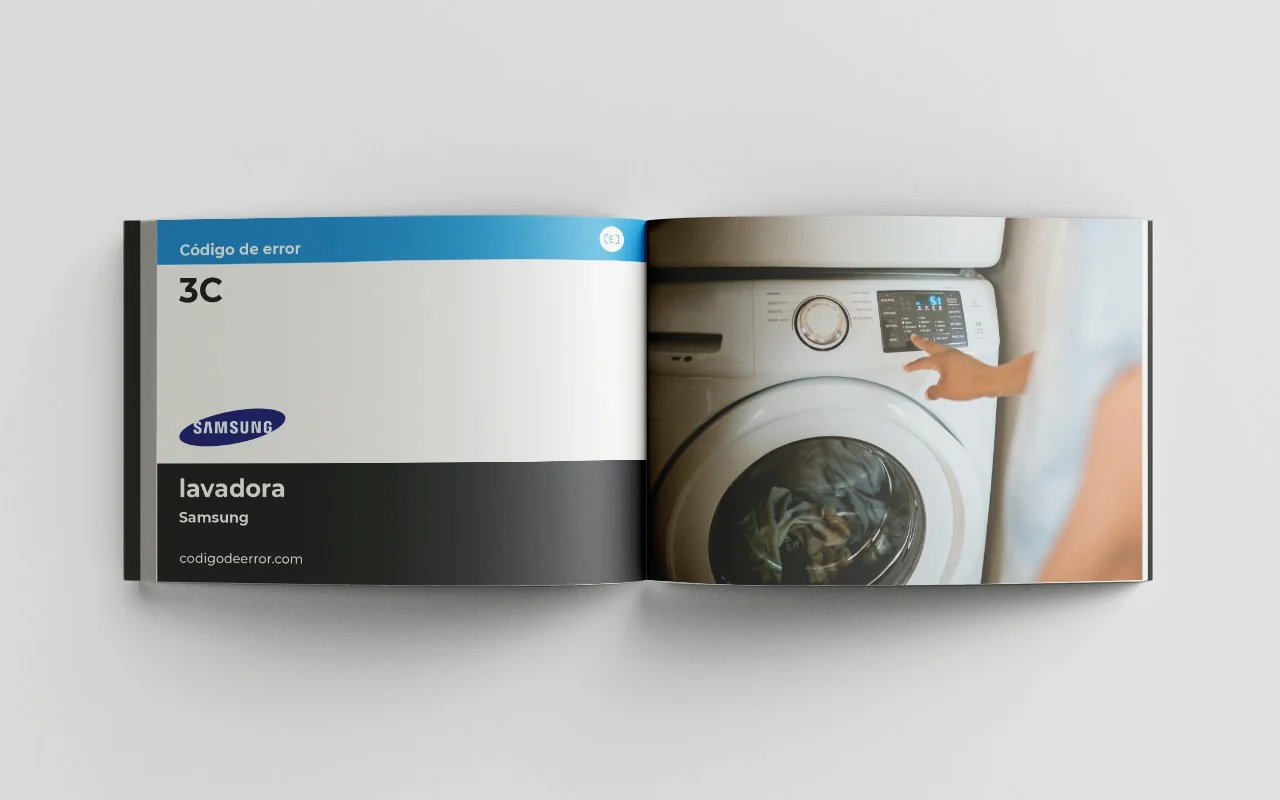
The 3C warning on a Samsung washing machine appears when the machine detects that the drum is not rotating as it should and protects itself to avoid further damage. In practice, the system is measuring a discrepancy between the movement command and the motor’s actual response, so the cycle stops right at the moment it needs the most precision, usually during the wash or before the spin cycle.
That message does not describe a single fault, but rather a spin control failure. There may be an unbalanced load, mechanical resistance in the drum, a speed sensor reporting incorrectly, wiring with intermittent contact, or an electronic problem governing the motor. Restarting can clear the warning for a few minutes, but it only solves the case if the anomaly was temporary.
If you have a problem with your washing machine, you can use our free error code finder. From there you can find out and solve all errors easily and effectively.
What the washing machine monitors when 3C appears
The system does not trigger the code by mere chance or from a generic reading. The electronics compare the motor’s expected speed with the real information it receives during operation, and if the response is weak, irregular, or simply does not match the program, it stops the cycle. That control protects the drum, the transmission, and the control board itself, because continuing to force the rotation could worsen the damage.
That is why 3C usually appears at moments of mechanical demand: when the washing machine tries to distribute the laundry, accelerate the drum, or begin the spin cycle. The visible symptom is a sudden pause, sometimes preceded by a short start attempt, a brief buzz, or an unnatural vibration. What the display shows is only the tip of the iceberg; underneath is a failed reading of movement.
In some homes the first reaction is to cut the power and turn it back on. That maneuver may help if there was a brief outage, electrical interference, or a momentary blockage in the system. But if the warning returns with the same load or at the same point in the program, the cause no longer seems temporary and it is worth looking beyond a simple reset.
The causes usually behind the warning
The most common explanation lies in the motor itself or its control. In brushed units, wear can affect contact and cause the rotation to lose strength or become unstable. In inverter motor models, the problem shifts to the electronic signal, the control that regulates movement, or the interpretation of speed. In both cases, the result is similar: the drum does not respond with the regularity the washing machine expects.
Another very common cause is physical resistance in the drum. A trapped garment, a load that is too compact, or a small object lost between the tub and the drum can increase friction and make rotation difficult. To the user it may seem like a minor inconvenience; to the washing machine, it is like trying to start with the brakes on.
The sensor that measures motor speed, known in many diagnostics as the tachometer, is also involved. If that part sends an incorrect reading, the board may interpret that the motor is not working properly even though it is trying. And the wiring and main board should not be forgotten: a loose connector, moisture, vibrations, or a damaged section can interrupt communication between the motor and the electronics without leaving obvious signs at first glance.
| Code | Description | Cause | What it indicates |
|---|---|---|---|
| 3C | Motor or spin failure | Motor, speed sensor, wiring, or board | The washing machine stops the cycle due to loss of movement control |
| 3C1 | Variant associated with the spin system | Motor, electronic control, or speed reading | Similar behavior to 3C with nuances depending on the model |
| 3C2 | Variant associated with the spin system | Motor, sensor, or control electronics | The unit detects an abnormal response from the drum |
| 3C3 | Variant associated with the spin system | Motor signal or internal communication | The washing machine blocks operation due to inconsistency in the reading |
| EC4 | Variant related to motor control | Problem with regulation or signal interpretation | The system interrupts the program for protection |
What to check before thinking about a serious fault
The first useful check is the load. An excessive load, very compacted or unevenly distributed, can make it hard for the drum to start and activate the system’s protection. It is not just about total weight, but how it is distributed inside the tub. A soaked blanket or several large garments balled together are enough to slow the movement and confuse the electronics.
Then it is worth looking inside with the machine unplugged and without forcing anything. If there is a hard object, a coin, a clasp, or anything trapped, that detail can become enough resistance to disrupt normal spinning. At this point, visual inspection matters: the drum should turn freely, without strange rubbing, without harsh knocks, and without a feeling of intermittent obstruction.
The power supply also deserves attention. A socket with poor contact, an unstable line, or a brief outage can alter motor behavior and cause the warning to appear only occasionally. When the problem only happens at specific moments, the cause may be the power supply or a temporary interference; when it repeats consistently, suspicion shifts toward the motor, sensors, or board.
Why turning it off and on only helps sometimes
Samsung explains that there is no miracle reset as such. What can be done is a full power-off cycle: unplug the washing machine or cut the power at the breaker for 1 to 5 minutes, wait for the residual electrical charge to disappear, and turn it back on. That gesture can clear a momentary reading and return the system to its initial state.
The problem is that clearing the message does not repair the cause. If the motor is still fatigued, the sensor continues to fail, or an intermittent cable breaks the signal, the washing machine will detect the anomaly again as soon as it tries to demand it once more. The display may stay clear for a while, but the fault will remain hidden in the electrical or mechanical path.
In addition, repeating restarts without observing the machine’s behavior later complicates the technical diagnosis. Each power-off erases part of the trail left by the system, and that information is often valuable for distinguishing between a start-up failure, a mechanical resistance, a reading problem, or a communication interruption. The wise thing is to note when it appears, with what load, and at which stage of the program.
When the origin is in the motor and when it is in the electronics
If the washing machine tries to start, vibrates with difficulty, and stops almost immediately, suspicion strongly points to the motor or its associated parts. In brushed models, wear can reduce contact and make operation erratic. In equipment with another drive technology, the focus moves to the electronic management that regulates rotation and monitors the drum’s response.
When the drum seems free but the code keeps returning again and again, the electronics become more important in the diagnosis. A faulty board can misinterpret the sensor signal or cut the rotation command for safety, even if no visible physical blockage exists. It can also happen that the wiring is partially damaged and the contact appears and disappears as the machine vibrates.
That intermediate point between mechanical and electronic is what causes the most confusion. A fatigued motor can seem like a defective board, and an altered speed sensor can mimic a general loss of power. That is why 3C is not fixed by guesswork, but by an ordered reading of symptoms: noise, vibration, drum response, exact moment of the failure, and repetition of the pattern.
The parts that usually end up in the workshop
In a professional repair, several parts may come under suspicion. The motor brushes are replaced when worn, the speed sensor is changed if it does not transmit information properly, and the affected wiring section should be replaced if continuity is interrupted. Each one performs a precise function within the circuit that allows the drum to move safely.
The main electronic board is usually the last part to be blamed without clear evidence, but it can also be behind the problem. When the board fails, the appliance not only loses its ability to spin; it also loses the judgment to decide how to start, how much to accelerate, or when to stop. At that point, the repair stops being a simple household intervention and requires exact compatibility with the model.
There is a notable difference between replacing something out of suspicion and doing it with a diagnosis. If the cause is a trapped object, removing it is enough. If the fault is in a sensor, it has to be tested. If the motor is fatigued, it is worth evaluating response and power consumption. And if the board generates erratic signals, replacement must be done with model accuracy, because the wrong reference can create more problems than it solves.
Signs that usually accompany the warning
Before the display shows 3C, the washing machine usually gives smaller warnings. A weak start, brief pauses during the wash, new vibrations, or a spin cycle that takes longer than usual are very useful clues. The machine rarely goes from normal operation to complete failure without leaving some traces first.
Sound also helps, though not definitively. A brief hum, a spin attempt that cuts out, or a dull, sluggish noise usually indicate that the motor is struggling against resistance. On the other hand, if the appliance seems to move well in one phase and only fails in another, electronic reading or internal communication becomes more important than purely mechanical wear.
Another valuable detail is repetition. If the failure always appears with heavy items, a duvet, or a very compact load, the link to imbalance is more likely. If it happens even with little laundry and under normal conditions, suspicion shifts toward a more structural problem, whether in the motor, the sensor, or the board.
How to reduce the risk of it appearing again
Prevention starts with how the washing machine is used. Not overloading the drum and distributing the laundry well reduces unnecessary strain on the motor. Large items need space to move; if the load becomes a dense, rigid mass, the system works with more friction and wear accelerates. It is also advisable to check pockets, zippers, and small objects before each wash.
The appliance’s physical stability matters more than it seems. A poorly leveled washing machine vibrates more, moves the load worse, and strains internal connections and parts. Add to that periodic cleaning of the interior, monitoring for moisture around sensitive areas, and checking that no objects are left in the drum or between the seal and the tub.
With prolonged use, the washing machine leaves small clues before giving a clear warning. A less powerful spin, a start that becomes progressively clumsier, or a new vibration are not decorative details. They are the way the machine says that something is starting to move outside the normal range. Listening to those signals in time is usually cheaper than waiting for a complete blockage.
When it no longer makes sense to keep trying and a technical inspection is advisable
If the warning returns after a few minutes, if the washing machine gets stuck in the same point of the program every time, or if the code appears accompanied by strange noises, it no longer seems like a passing fault. In that scenario, repeating the reset adds no value. The sensible thing is to move on to a diagnostic review with tools, not trial and error.
3C does not name the culprit by itself. It points to an interruption in the spin system, but the cause may be in the motor, a sensor, the wiring, or the control board. That breadth explains why two washing machines with the same message may need different solutions, from cleaning or redistributing the load to a more serious electronic repair.
The good news is that this warning does not always signal a serious breakdown. The bad news is that, when it repeats, it is no longer wise to treat it as a mere stumble. The washing machine speaks through its own sequence of failures, and 3C is usually a clear wake-up call: stop forcing the cycle and look for the real cause before the problem becomes more expensive and more obvious.
A useful alarm before the damage gets worse
The value of code 3C lies precisely in its preventive function. The washing machine stops so as not to worsen a spinning fault that, if ignored, could affect the motor, the transmission, or the associated electronics. It is not a useless obstacle: it is an intelligent brake that prevents a small anomaly from turning into a larger failure.
That is why the correct approach combines calm and careful reading. First, the simplest causes are ruled out: excess load, trapped objects, poor leveling, or a brief electrical incident. Then the behavior of the motor, the sensor response, and the quality of internal communication are assessed. Only then does the diagnosis stop being approximate and start to make sense.
In a home full of routines, a washing machine that stops dead can seem like just another nuisance. But the warning has a precise, almost mechanical logic, and it is worth respecting it. When the drum does not turn as it should, the machine says so clearly. Listening to that signal in time often makes the difference between a simple fix and an unnecessarily large repair.
Este artículo contiene enlaces de afiliado: si compras a través de ellos, se genera una pequeña comisión sin coste adicional para ti. Más información.


F37 error on a Balay washing machine: meaning and safe solutions

F26 error on a Balay washing machine: meaning and fix

Balay ceramic hob F2 error: causes and safe solution
F2 error on a Balay washing machine: causes and safe solutions

Balay F2 Error With the Hob Off: Causes and Fixes

F18 error on a Balay washer-dryer: causes and fixes

F11 error on a Balay dryer: meaning and safe solutions

F01 error on a Balay washing machine: meaning and action

F0 error on a Balay cooktop: causes and solutions

Balay F0 error on hobs: causes and safe solutions

 Dishwasher6 days ago
Balay dishwasher E15 error: warranty coverage and solution
- Dishwasher6 days ago
Balay dishwasher E16 error: causes and safe solution
- Balay6 days ago
Balay washing machine E2 error: causes and safe solutions
- Dishwasher6 days ago
E17 error on a Balay dishwasher: causes and safe solution
- Appliance4 days ago
Smart appliances for a secure connected home
- Dishwasher6 days ago
E15 Error on Balay Dishwasher: Causes and Safe Solution
- Dishwasher6 days ago
Balay dishwasher E19: causes and safe solution
- Balay6 days ago
E19 error in Balay dishwasher: causes and solution
- Appliance4 days ago
Efficient appliances to save water at home
- Appliance4 days ago
Electrodomésticos con IA: funciones, límites y compra útil
- Balay5 days ago
E21 error on a Balay washing machine: causes and safe fixes
- Balay6 days ago
E18 error on the Balay TW 7412 washing machine: causes and fix


