Drying machine
F06 Error on Fagor Dryer: Causes, Symptoms, and Solution
The warning indicates a fault in the heat system. These are the parts involved and how to narrow down the fault methodically.

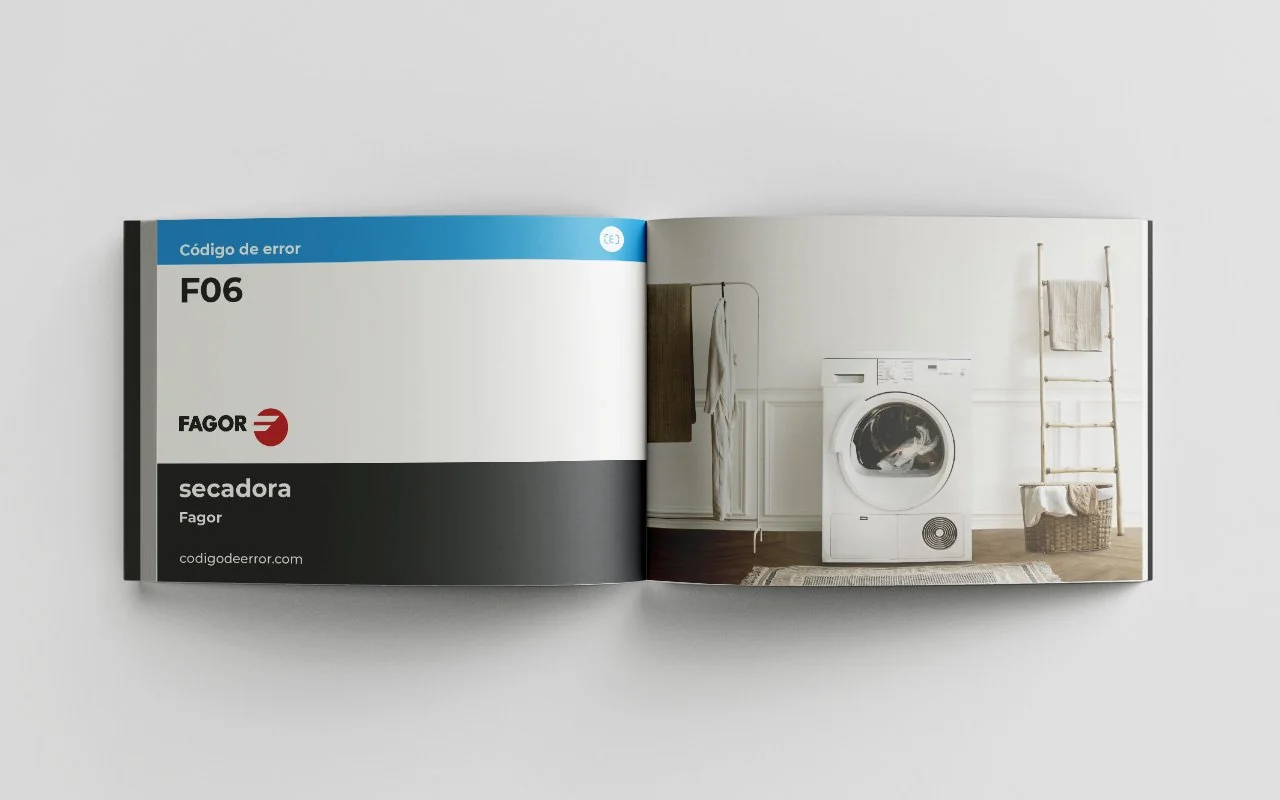
The F06 error in a Fagor dryer usually appears when the appliance detects an anomaly in the heating system and stops the cycle before continuing to force the assembly. The practical consequence is very recognizable: the drum may spin, but the clothes come out damp, the program gets stuck, or the machine stops without reaching the required temperature.
Behind that warning there is usually not just one guilty part, but a fault in the thermal chain. In most cases, attention falls on the heating element, the thermostat, the NTC sensor, the wiring, or the electronic board. Rather than pointing to a broken component, the code warns that the system is no longer receiving or returning a coherent heat reading.
If you have a problem with your dryer, you can use our free error code finder. From there you can find out and solve all errors easily and effectively.
What the dryer is protecting when it shows F06
The electronics in a Fagor dryer do more than just tell it to heat or stop; they also compare signals. When that comparison does not match up, it interrupts the cycle for safety. It is a logical reaction: if the temperature does not rise as it should, if it rises too much, or if the system cannot measure it accurately, continuing to operate can make the fault worse.
That is why F06 should not be read as an isolated usage error or as a display whim. Deep down, the machine is saying that its thermal circuit has lost stability. It may still power on, the motor may sound normal, and the drum may move, but drying stops being reliable because the heat is no longer under control.
It is also important to distinguish between a one-off incident and a recurring fault. A bad contact, a voltage fluctuation, or an unusual sensor reading can trigger the warning just once. If the code keeps coming back, the diagnosis changes: it is no longer a suspicion, but a worn component or a signal that is reaching the board improperly.
The parts most often behind the warning
The heating element is the first part worth checking. It is responsible for producing the heat that dries the clothes, and it works in a demanding environment, with lint, moisture, long cycles, and constant temperature changes. When it fails internally or loses correct values, the dryer stops heating normally and the electronics interpret the fault.
Alongside it is the thermostat, which acts as a thermal guardian. Its job is simple in appearance and decisive in practice: to prevent the temperature from getting out of hand. If it stays open, responds too late, or provides an incorrect reading, the appliance may cut the heat too early or block the cycle as a preventive measure.
The NTC sensor adds another layer of control. This sensor converts the temperature into an electrical signal that the board can understand. When the measurement becomes inaccurate, the dryer may think the inside is cold, overheating, or changing temperature in jumps. In any of those scenarios, the result is usually the same: the program stops and F06 appears.
The fourth area is the wiring and connectors. A loose terminal, an overheated cable, a corroded connection, or a damaged track can produce the same effect as a broken component. Electronics do not always distinguish between a faulty heating element and a signal that is not reaching it properly; that is why the entire circuit path deserves as much attention as the visible part.
When everything above seems correct, the focus shifts to the electronic board. At that point the problem is no longer just heat generation, but management. A worn relay, a cracked solder joint, or a sensor-reading fault can disrupt the dryer’s internal logic and trigger a protective lockout.
| Code | Description | Cause | Items to check | Usual effect |
|---|---|---|---|---|
| F06 | Failure in the heating system | Heating element, thermostat, NTC sensor, wiring, or board with abnormal reading | Heating element, thermostat, NTC, connections, and electronic module | The dryer spins, but does not dry or stops the program |
Signs that accompany the problem before the cycle locks up
The clearest clue is clothes that come out cold or damp after an apparently complete program. Often the drum spins normally and the remaining time counts down, but the air never reaches the right temperature. You notice the result immediately when you touch the garments: they feel heavier, retain moisture, and do not have the expected dry feel.
Another common sign is the program getting stuck in a particular phase. The dryer may take longer than normal to finish, repeat attempts, or change behavior without a clear pattern. That kind of irregularity usually points to an unstable thermal reading, not to a mechanical problem with the drum or the laundry load.
In some cases, more subtle clues appear: a slight overheated smell, a feeling of uneven warmth on the casing, or partial drying, with some items almost ready and others still wet. That mix of symptoms is especially useful because it suggests that the system heats unevenly before failing completely.
It is worth not confusing this picture with a simple overloaded load. An overloaded dryer may dry worse, yes, but it does not usually generate an F06 code on its own. When the warning appears, the appliance is detecting a technical anomaly that goes beyond the amount of laundry or poor load distribution.
How to narrow down the fault without guessing
The first step is to disconnect the dryer from the mains. This is not a minor formality. Any internal inspection, however simple it may seem, must be done with no power to avoid shocks, incorrect readings, or additional damage to connectors and sensitive components.
Then, a visual inspection can provide valuable clues. A blackened cable, a loose terminal, traces of lint accumulated around the thermal assembly, or signs of abnormal heating help steer the diagnosis. This check does not replace electrical testing, but it avoids unnecessary disassembly and shows where to look first.
Checking the heating element and the NTC sensor requires a measuring instrument and some experience. A damaged heating element may show incorrect continuity or an out-of-range value, while a worn NTC provides inconsistent readings. Without measuring, it is easy to confuse a truly faulty part with one that only seems suspicious because it is near the heat.
If those elements respond well, the next logical step is to inspect the thermostat and its associated wiring. A thermostat that cuts out too early or a circuit with an intermittent contact can cause intermittent symptoms, which are among the most frustrating because sometimes the dryer seems to work and sometimes it does not. That is one of the keys to this fault: it does not always behave consistently.
When the thermal section seems correct and F06 still persists, the focus shifts to the board. At that point, looking at parts is not enough; you have to think about control, signals, and internal continuity. The fault may be in a relay, in a solder joint, or in a track that no longer conducts properly.
Which repairs usually restore normal operation
The most common solution, when diagnosis confirms it, is to replace the faulty heating element. It is a part subject to real wear, and when it fails, persisting with it does not help. If it does not produce heat or does so erratically, the dryer will hardly be able to complete drying reliably.
If the problem is in the thermostat or the NTC sensor, replacing the affected component is usually enough to restore a reliable thermal reading. They are small parts, but the electronics depend on their precision to decide when to heat and when to stop supplying heat.
When the source is in the wiring, the repair consists of restoring continuity and eliminating poor contacts. Sometimes it is enough to redo a connection, replace a terminal, or correct an overheated point. These are less visible interventions than changing a heating element, but they often solve the problem without touching more than necessary.
The electronic board is the most delicate scenario. If the fault is localized, the affected component can be repaired; if the damage is widespread, complete replacement is usually the most sensible path. At that point, economic judgment matters as much as technical judgment, because investing in an old module does not always make sense when the dryer already has years of intensive use behind it.
Dirt matters more than it seems. Poor cleaning of filters, ducts, or ventilation areas does not usually cause F06 on its own, but it does worsen system cooling and accelerate wear on the thermal section. Poorly evacuated heat puts extra strain on every part, like an invisible extra load.
What to avoid so as not to make the fault worse
It is not a good idea to keep restarting it repeatedly as if the code were temporary. When the warning returns, the dryer is signaling a real problem in the heating circuit. Repeating cycles without checking anything can strain a weakened heating element or subject the board to unstable signals for longer than necessary.
Randomly taking parts apart does not help either. In a dryer, order matters. A wrongly placed connector, a sensor moved out of position, or an incorrectly interpreted electrical test can complicate a fault that may have been simple. Proper diagnosis follows a method: first safety, then measurement, and only then replacement.
Internal cleaning deserves more respect than it often gets. Built-up lint is not always the main cause of the problem, but it can act as a backdrop. If air circulates poorly, the heating element works harder and temperature becomes less stable. The whole system suffers, as if it were breathing through a scarf.
It is also a bad idea to ignore the warning if the dryer still spins. That detail is very misleading, because it seems as though the appliance is still alive and only a minor function has failed. In reality, drying depends precisely on the part that F06 is protecting, and continuing to use it like this can turn a specific repair into a more extensive fault.
When repair makes sense and when the age of the appliance matters more
A Fagor dryer with F06 is not doomed by definition. If the fault is limited to a heating element, thermostat, or NTC sensor, the repair usually makes sense and can significantly extend the appliance’s useful life. These are identifiable faults, with specific parts and a reasonable cost-benefit ratio in many homes.
The assessment changes when the problem jumps from one component to another or when the board shows widespread wear. In units with many years of service, it is not uncommon for chain failures to appear: first an erratic thermal reading, then a worn contact, and finally a more persistent lockout. At that point, the technical diagnosis and the value of the appliance must be considered together.
Previous use also plays a role. A well-maintained dryer, with clean filters, proper ventilation, and a reasonable load, usually responds better to a one-off repair. A machine subjected to constant humidity, overloading, or little maintenance tends to accumulate small internal stresses that eventually show up as repeated codes.
Seen in perspective, F06 is not just about a fault. It is about temperature, control, and safety. It also says something about the overall condition of the machine. When the thermal circuit is still recoverable, repair is a reasonable option. When the problem spreads across several layers, the decision requires more cool-headedness than nostalgia.
A technical warning that stops in time to avoid greater damage
The real value of F06 lies in its protective function. The dryer stops because it has detected an inconsistency in the system that produces or measures heat. This interruption, although annoying, prevents the appliance from operating under abnormal conditions and reduces the risk of damaging more expensive or delicate components.
Read calmly, the warning narrows the search field quite a bit. It does not point to the drum, it does not blame the laundry load, and it does not describe a vague fault. It places the problem in the thermal circuit and allows you to work with a fairly clear logic. In repair, that precision is worth gold because it saves pointless tests and unnecessary replacements.
That is why the F06 error in a Fagor dryer should not be treated as an electrical mystery. It is usually a well-targeted alarm that points to a specific part of the appliance and calls for an orderly check of the heating element, sensors, thermostat, connections, and board. When interpreted that way, the repair stops being a guess and becomes a diagnosis again.
The difference between a well-resolved fault and a chain of expenses lies there: not skipping steps and not confusing a symptom with its cause. The dryer warns you before going any further; making use of that warning wisely is the most sensible way to stop the problem in time.
Este artículo contiene enlaces de afiliado: si compras a través de ellos, se genera una pequeña comisión sin coste adicional para ti. Más información.


F37 error on a Balay washing machine: meaning and safe solutions

F26 error on a Balay washing machine: meaning and fix

Balay ceramic hob F2 error: causes and safe solution
F2 error on a Balay washing machine: causes and safe solutions

Balay F2 Error With the Hob Off: Causes and Fixes

F18 error on a Balay washer-dryer: causes and fixes

F11 error on a Balay dryer: meaning and safe solutions

F01 error on a Balay washing machine: meaning and action

F0 error on a Balay cooktop: causes and solutions

Balay F0 error on hobs: causes and safe solutions

 Dishwasher7 days ago
Balay dishwasher E15 error: warranty coverage and solution
- Dishwasher7 days ago
Balay dishwasher E16 error: causes and safe solution
- Balay7 days ago
Balay washing machine E2 error: causes and safe solutions
- Dishwasher7 days ago
E17 error on a Balay dishwasher: causes and safe solution
- Dishwasher7 days ago
Balay dishwasher E19: causes and safe solution
- Balay7 days ago
E19 error in Balay dishwasher: causes and solution
- Appliance4 days ago
Smart appliances for a secure connected home
- Dishwasher7 days ago
E15 Error on Balay Dishwasher: Causes and Safe Solution
- Appliance4 days ago
Electrodomésticos con IA: funciones, límites y compra útil
- Appliance4 days ago
Efficient appliances to save water at home
- Balay7 days ago
E18 error on the Balay TW 7412 washing machine: causes and fix
- Balay6 days ago
E21 error on a Balay washing machine: causes and safe fixes


