Ceramic hob
F5 error on Fagor ceramic hob: causes and real solution
Discover why this fault appears, which parts are usually behind it, and when it’s advisable to check the board or call a technician.


On a Fagor ceramic hob, the F5 warning usually points to an internal communication problem or a fault in the control electronics, and it almost always translates into a cooktop that poorly detects the load, does not respond normally, or enters protection before heating. In some models, the symptom appears together with flashing numbers, beeps, or intermittent power activation; in others, the zone is directly locked and the hob behaves as if it were disconnected.
The key is not to confuse this warning with a simple usage lockout. The F5 error on a Fagor ceramic hob is usually related to the electronic section, sensors, or components that deteriorate due to temperature, humidity, or wear. There may be a simple and reversible cause, but there may also be a board failure that requires technical intervention and, in some cases, replacement of modules or capacitors.
If you have a problem with your hob, you can use our free error code finder. From there, you can find out and solve all errors easily and effectively.
What the F5 warning really indicates on a Fagor ceramic hob
The F5 code does not describe a single closed failure, but rather a set of faults affecting the electronic control of the hob. In practice, the electronics do not correctly interpret a command, do not properly validate the presence of cookware, or find an anomaly in communication between its modules. That is why the user sees a hob that is half-on, with alternating lights or zones that seem to start up and stop instantly.
This behavior matches what happens inside the hob: a signal is cut off, a sensor does not deliver the expected value, or a power stage does not respond as it should. The ceramic hob has no way to explain the problem in a clearer language; that is why it summarizes everything in a code. F5 is, essentially, a control alert, not a common usage fault or a simple mistake when placing a pan.
On some units, the fault appears after an episode of accumulated heat. A very large pot, poor ventilation, or a piece placed on top of the panel can raise the temperature of the electronics enough to push it out of range. In other cases, the fault originates in small, almost invisible components, such as SMD capacitors or connections fatigued by time. The difference matters, because a overheated board is not repaired the same way as a board with a damaged track or broken communication.
The symptoms that usually accompany the fault
The clearest sign is that the hob stops heating normally. Sometimes the power indicators turn on and off in short cycles, as if the cooktop were breathing with difficulty. Other times the selected zone does not even start up, even though the panel seems to respond to touch. The user hears the beep, sees F5, and notices a kind of cold, almost clinical lockout.
It is also common for the fault to appear intermittently. The hob may work for a few minutes and then fail, especially when the electronics heat up. That pattern is very telling: when the error changes with temperature, there is usually a degraded component, a tired solder joint, or an insufficient ventilation system. The fault is not always permanent from the first day; it often begins as a whim and ends as a complete shutdown.
It is also worth looking at the immediate area around the hob. If there is grease, food residue, moisture, or an object resting on the panel, the sensitivity of the controls may be altered. However, in typical F5 cases on Fagor hobs, cleaning the surface is not enough. The symptom may calm down for a moment, but it returns because the real cause is deeper, in the electronics that govern the whole unit.
What causes are most common behind the problem
The first reasonable suspicion is a failure in communication between modules. The board of a ceramic hob does not work as a single simple piece; it combines control, detection, and power, and it needs each part to deliver coherent signals. When that dialogue is interrupted, the hob enters an error state. A loose cable, a corroded connector, or a cracked solder joint is enough to break the internal conversation.
The second common cause is overheating. The power electronics work close to the thermal limit and depend heavily on ventilation. If the fan is obstructed, if the extractor hood does not remove heat well, or if the built-in installation leaves too little air space, the board accumulates temperature and starts to fail. In that scenario, the F5 code may coexist with a faint smell of hot plastic or sudden shutoffs that seem random, but are not.
There are also failures in specific components, especially capacitors and power supply elements. These are small parts, but their role is decisive in stabilizing voltage. When they dry out, deform, or lose capacity, the board can become erratic. A weakened capacitor does not always leave the hob dead; sometimes it makes it unstable, which is exactly the terrain where errors of this type flourish.
Finally, damage to the control board itself or the power stage should not be ruled out. A surge, a voltage spike, or a poorly executed previous repair can leave a mark. In those cases, the problem is no longer a loose connection, but a more serious fault that requires diagnosis with instruments and reading real values.
What you can check without taking the hob apart completely
The most basic check is to cut power for a few minutes and reconnect the hob. It is not a miracle solution, but it is a clean way to rule out a temporary electronic lockout. If the code disappears and the ceramic hob resumes working, the fault may have been isolated. If it comes back immediately, the fault is still active and you should avoid forcing the hob.
Then it is worth observing the control area calmly. Any object left on the panel, a damp cloth, a dried splash, or a hot container resting on top can alter the reading of the touch controls. In sensitive models, external overheating of the panel generates errors that are very similar to a serious fault. The surface must be clear, clean, and dry, because capacitive touch does not tolerate physical interference well.
Ventilation can also be assessed without tools. If the hob gives off excessive heat, if the fan never sounds, or if the underside of the cabinet is very closed off, there is a clear clue. Modern ceramic hobs depend on a constant airflow, just like a small motor. When that air is missing, the symptoms appear like in a room without breathing: first it struggles, then it locks up.
When the problem points to an electronic repair
If the F5 persists after rebooting and there is no object on the panel, the focus shifts to the inside of the hob. At that point, cleaning or switching it off and on is not enough. The unit needs to be opened, the power supply checked, control components inspected, and it must be verified whether the modules are communicating with the correct values. That part cannot be solved by eye.
In the workshop, the most useful diagnoses focus on three areas: the condition of capacitors, the integrity of connections, and the operation of the power system. When one of those parts fails, the symptom may be F5, but it can also be mixed with shutoffs, beeps, or a complete lack of response in a specific zone. The visible error is the tip of the iceberg; underneath is an electrical fault that needs real checking.
Repair is feasible in many cases, but it is not always worth keeping the original board if the damage is extensive. If the power stage is severely affected or several zones are damaged, replacing the entire board may be the most sensible option. The decision depends on cost, the model, and the condition of the circuit, not on a fixed rule. In appliance electronics, two boards with the same code can hide very different stories.
Why the hob does not detect the load properly in some models
In certain Fagor models, F5 is associated with faulty cookware detection or an incorrect reading by the control system. That does not always mean the pan is bad. It may happen that the base is not properly centered, that the diameter is too small for the selected zone, or that the cookware is not compatible with the system. In induction hobs, the cookware must have a ferromagnetic base; in conventional ceramic hobs, the logic changes, but the control still needs clean signals.
When the electronics misinterpret the situation, the hob protects itself. It is sensible behavior from the manufacturer’s point of view, because it prevents greater damage. The downside is that the user sees an appliance that seems to refuse to cook without any apparent explanation. Internal protection can give the impression of a major fault, even though it is actually only defending the system from inconsistent data.
That is why the correct diagnosis does not consist only in looking for an external cause. You have to check the cookware, ventilation, panel cleanliness, and the condition of the electronics. The combination of signals is usually what guides the case. If the fault appears with any cookware and in several zones, suspicion moves away from the kitchenware and toward the control board.
What a technician does when they find this code
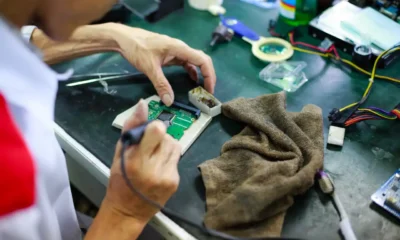
A specialized service does not just read the error and replace parts at random. First it inspects the board and locates visible damage: swollen capacitors, darkened areas, loose connectors, or tracks with signs of overheating. Then it measures voltages, checks communication between modules, and verifies whether overheating has left traces on the circuit. It is work with a magnifier and multimeter, not improvised intuition.
If the problem is isolated, sometimes it is enough to replace a specific component, reinforce a solder joint, or clean the affected area. In other cases, the board is already too damaged and needs to be replaced. Electronic repair is usually cheaper than replacing the entire board, but only when the damage is localized and the rest of the circuit still has room to work.
It is also common to check the general ventilation of the cooktop and the condition of the home’s electrical installation. Poor power supply, a worn socket, or a line with voltage drops can worsen a fault that was already latent. In kitchen appliances, the installation matters as much as the faulty component; an unstable electrical base is like a floor creaking under a heavy piece of furniture.
How to prevent it from appearing again
Prevention starts with simple habits. Keeping the panel clear, not placing hot pots on the control area, and cleaning any spill as soon as the surface cools reduces the risk of false readings. It is also advisable to respect the manufacturer’s ventilation clearances, something that is often overlooked when the hob is fitted too tightly into the kitchen cabinet.
Care for cookware also helps. Deformed, dirty, or unstable bases can cause odd behavior in sensitive hobs and increase the workload of the electronics. And although a ceramic hob does not depend on compatible cookware like an induction hob, it still needs the interaction between the heat source and the panel to be stable. Less thermal stress means less wear, and that shows over the years.
One point that is often forgotten is the home’s electrical environment. Voltage surges, loose sockets, and old installations heavily punish control boards. A modern appliance can last for years, but it is not made to live with a poor electrical supply. When the power is irregular, the electronics age earlier and faults like F5 appear more easily.
What this fault reveals about modern cooking electronics
The F5 warning reminds us that modern hobs are no longer just hot surfaces, but small power computers. They measure, calculate, correct, and protect themselves. That sophistication brings convenience, but also a new fragility: a damaged solder joint or a tired capacitor can take an entire cooktop out of service. The surface remains smooth and elegant; underneath, however, there is a delicate, almost nervous system.
In Fagor ceramic hobs, as in many others, the error language serves as an early alarm. Ignoring it or forcing the appliance does not improve the situation. F5 is not just a letter on the display; it is a warning that something in the electronic chain has lost coherence. Understanding it in time avoids more expensive failures and helps decide whether it is worth repairing, checking, or replacing.
The most useful reading, in reality, is not technical but practical: if the hob shows the fault repeatedly, the cooktop has already made it clear that it needs serious intervention. Sometimes it will be a discreet component repair, other times a replacement of the main board. The important thing is not to confuse a visible symptom with the deep cause. In this kind of fault, the display says little, but it says it precisely.
Este artículo contiene enlaces de afiliado: si compras a través de ellos, se genera una pequeña comisión sin coste adicional para ti. Más información.


Balay washing machine F4 error: how to restore drainage

Error in a 2013 Balay A++ refrigerator: causes and fixes

Balay induction hob error 22: how to fix it

E17 error in the Balay 3TS60107 washer: causes and fix

Balay washing machine E93 error: causes and safe solution
E9 error on a Balay induction hob: causes and solution
E9 error on a Balay induction hob: causes and solution

Balay E9 error on a freezer: causes and solution

E80 error on a Balay washing machine: meaning and solution

Balay washing machine E80 error: meaning and what to do

 Kitchen plate7 days ago
E Error on Balay Series 900 Hob: Causes and Solutions
- Kitchen plate7 days ago
Balay induction hob E error: causes and solutions
- Washing machine6 days ago
Hotpoint washing machine F09 error: what it means and what to do
- Balay6 days ago
E05-32 error on a Balay oven: causes and safe solution
- Balay5 days ago
E09 error in Balay dishwasher: causes and safe solution
- Dishwasher5 days ago
E15 error on Balay dishwasher: do not tilt it
- Dishwasher5 days ago
E09 error in Balay dishwashers: causes and safe solution
- Dishwasher4 days ago
Balay dishwasher E15 error: warranty coverage and solution
- Balay5 days ago
Balay washing machine E12 error: causes and safe solution
- Balay4 days ago
Balay washing machine E2 error: causes and safe solutions
- Balay5 days ago
E09 error in Balay dishwasher 3VS503IA: causes and fix
- Dishwasher4 days ago
Balay dishwasher E16 error: causes and safe solution