Drying machine
E5E error in Electrolux dryer: causes and solution
An internal communication failure can stop the cycle. These are the most likely causes and the basic checks.

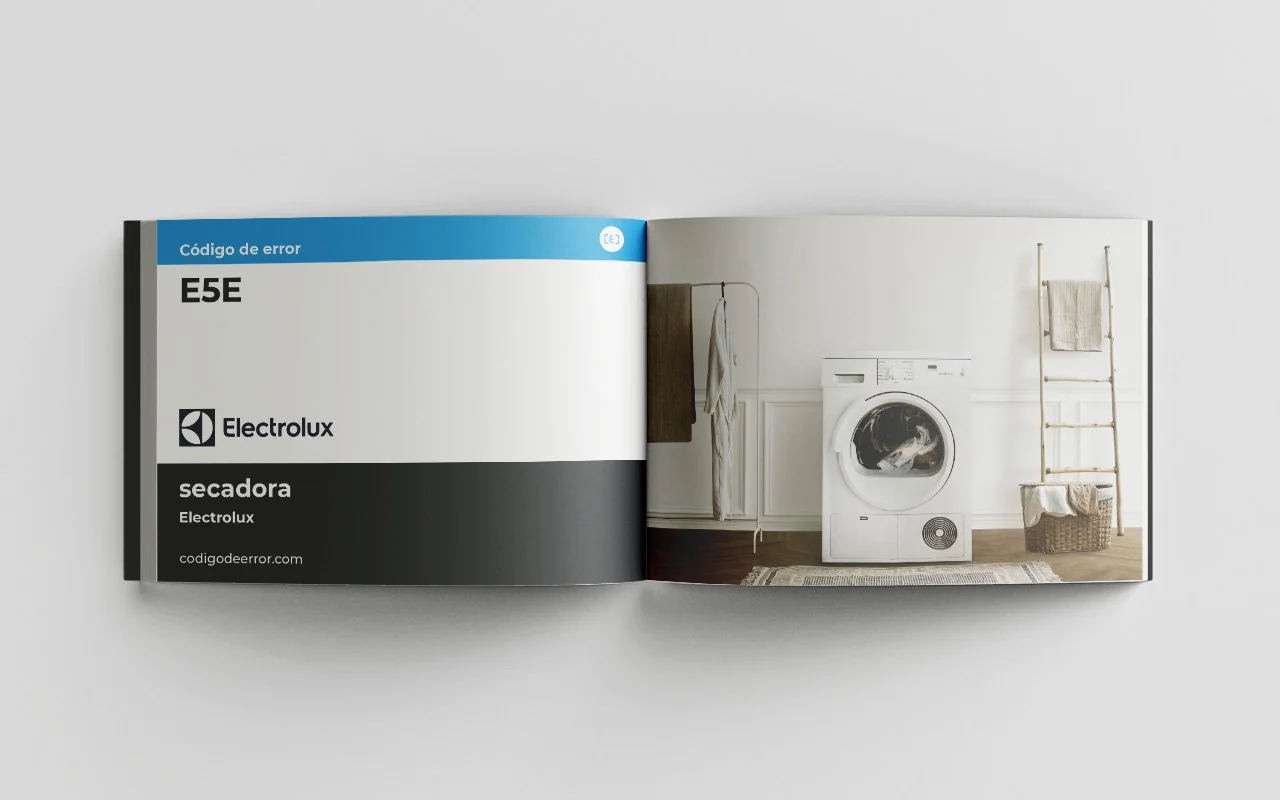
The E5E alert on an Electrolux dryer indicates a communication failure between the main board and the module that controls the motor. When that internal conversation breaks down, the appliance may refuse to start, stop the cycle halfway through, or react with erratic behavior that does not match a common mechanical fault.
This code does not point to dirty filters, a full tank, or a drying problem caused by overload. It refers to control electronics, connections, and signals that are not reaching where they should. In practice, the source is usually a worn connector, damaged wiring, deteriorated traces on the board, or the power module itself.
If you have a problem with your dryer, you can use our free error code finder. From there, you can find out and fix all errors easily and effectively.
What the E5E code really communicates
The dryer depends on a continuous exchange of signals to coordinate startup, drum rotation, sensor reading, and motor response. When that exchange is interrupted, the system protects itself and stops operation before a minor electrical fault turns into a major breakdown.
In Electrolux models, the E5E code usually appears when the main board can no longer communicate with the module in charge of the motor. It is an internal issue, silent in appearance but very specific: the appliance is not saying it lacks ventilation or has a simple door lock problem, but rather that the electronic logic has lost synchronization.
That distinction matters because it prevents mistaken diagnoses. A dryer may look fine on the outside, but if internal communication fails, the result is the same as if it were unplugged halfway through a job: the cycle is interrupted and the unit waits for a command it cannot interpret.
The useful table for distinguishing the source of the fault
In workshops and home inspections, E5E is best interpreted when its possible causes are separated according to the affected area. The following table summarizes the scenario with the most useful information for guiding a reasonable inspection without turning diagnosis into a blind guess.
| Code | Description | Cause | Common symptoms | Suggested solution |
|---|---|---|---|---|
| E5E | Internal communication failure between the main board and the motor module | Loose connectors, worn wiring, damaged traces, or a faulty module | The dryer does not start, stops halfway through the cycle, or responds irregularly | Check visible connections, verify continuity, and assess the electronic board |
What to check before thinking about a major breakdown
The first sensible check is always electrical and basic. Disconnecting the dryer from power for several minutes can clear a momentary lockup caused by a voltage fluctuation or a one-off faulty reading. This does not repair a broken board, but it does help rule out a transient fault that may have been stored in memory.
It is also worth observing how the machine behaves just before the warning appears. If the drum tries to move and then stops, if the panel responds slowly, or if the error appears at startup, the clue strongly points to the control electronics. When the fault is communication-related, the symptoms are rarely dramatic; instead, they appear as small inconsistencies that eventually prevent the cycle from continuing.
Safety is not an add-on, but part of diagnosis. Before removing covers or touching connectors, the dryer must remain de-energized. A modern drying appliance concentrates heat, current, and delicate components in a small space, and that combination does not allow improvisation or forced maneuvers.
Why it appears in this type of fault
The most common cause is the wiring that connects the main board to the motor module. Vibration from use, accumulated heat, and the passage of time can loosen a terminal, dry out insulation, or create an intermittent contact that is not visible to the naked eye. Sometimes everything seems correct until the connector is under load and the signal drops out.
It is also possible for the damage to be inside the board itself. A burnt trace, a fatigued solder joint, or a corroded area is enough to break continuity. In this area, the fault can hide like a fine crack in glass: from a distance it is almost invisible, but it completely alters how the whole assembly behaves.
To a lesser extent, the problem may be located in the module that controls the motor. If that component stops responding as the main board expects, the system interprets it as a communication loss and locks the dryer. That is why E5E is not resolved well by intuition; it requires an orderly reading of each section of the circuit.
How diagnosis is approached with sound judgment
The order of inspection makes the difference between a useful check and an unnecessary replacement. First the accessible connectors are inspected, then the visible condition of the wiring, and only later the board and its components. That sequence saves time and reduces the risk of replacing an expensive part because of a simple terminal that is not seated properly.
When the error returns after a reset, the room for attributing it to a one-off issue shrinks a lot. If the warning appears repeatedly, the problem is no longer behaving like an isolated lockup, but like a persistent communication fault. At that point, a visual inspection may not be enough and testing with measuring tools becomes essential.
Technical diagnosis usually checks continuity, power supply, and signal stability between boards. It is a precise task, because a connector can look fine and fail when the machine is working, or a damaged trace can function for a few seconds and then cut out. That intermittency explains why this code is so confusing to anyone not used to reading appliance electronics.
What the user can do without taking unnecessary risks
Beyond resetting and temporarily disconnecting power, the home margin is limited. Even so, there is valuable information that can help pinpoint the repair: whether the error appeared after a power surge, whether the dryer has recently been moved, or whether there was moisture at the back. All of that helps define the real cause.
Transport and vibration can loosen internal connections. It does not take a spectacular failure for a terminal to become partially misaligned. That is why some dryers work normally for a while and then fail without any obvious pattern, as if they were following a capricious logic. In reality, they are usually warning of an unstable contact.
It is advisable to avoid opening sealed modules or forcing connectors without knowing how they are anchored. Aging plastics break easily and a clumsy intervention can make the problem more expensive. In an electronic fault, caution is not a form of passivity, but the cleanest way not to worsen an already delicate issue.
When the problem clearly calls for technical service
If the E5E warning keeps coming back after resetting the machine, professional inspection is no longer a secondary option. The same applies when the dryer does not complete startup or the drum stops halfway through the process. In those cases, the fault no longer seems like a temporary stumble, but a stable defect in internal communication.
The smell of an overheated component, dark marks on the electronics, or a panel that responds strangely are signs that deserve immediate attention. These symptoms are not usually solved by trying again and again; they usually indicate that something has worked beyond its normal limits and that the problem is in the electrical section, not in the appliance’s everyday use.
Technical intervention is also recommended if the dryer shows intermittent faults that are difficult to reproduce. This kind of breakdown requires experience, measurements, and access to the board. In many cases, the solution involves correcting a connection, repairing a trace, or replacing the affected module before the deterioration advances.
Why this warning is easier to interpret than other ambiguous faults
The value of E5E is that it separates an internal electronic failure from other more common problems. It is not an alert about ventilation, residual moisture, or accumulated dirt; that completely changes the approach. A reader who correctly identifies this code avoids wasting time cleaning parts that are not at the origin of the fault.
When the error suddenly appears in a dryer that had been working normally, the clue usually points to an electrical interruption or a loss of communication. If, on the other hand, the unit had already shown strange signs before the warning, the fault may have been developing for some time inside the board or its connections.
Reading the code accurately makes it possible to act sensibly. The point is not to keep resetting it over and over like someone tapping a radio to get the signal back, but to decide whether a basic check is enough or whether the electronics now require a deeper inspection.
When electronics override the rest of the symptoms
In modern appliances, electronics matter more than any noise or vibration. A communication fault can stop the machine even if the drum turns normally by hand, the motor shows no visible damage, and the sensors seem fine. The appliance protects itself because it has lost the minimum coordination needed to operate.
That hidden nature explains the feeling of sudden lockup. From the outside, the dryer seems intact; inside, however, the conversation that orders each rotation, pause, and system response has disappeared. The E5E error behaves like a line cut in a telephone exchange: everything is still there, but no one understands each other.
Understanding that logic helps avoid blind repairs. Attention should focus on the connections, the integrity of the board, and the motor module involved in the signal exchange. That is where it is decided whether the dryer returns to normal operation or is definitively taken out of service.
An apparently small fault, but decisive in operation
E5E does not describe a visible break or a fault that can be seen from afar. It describes a crack in the appliance’s internal language, and in an Electrolux dryer that language governs everything: startup, cycle stability, command reading, and motor response. If it breaks, the entire cycle is compromised.
Dealing with it in time prevents a localized problem from becoming a major breakdown. In compact equipment, where heat, vibration, and electronics live very close together, a tiny detail can decide whether the appliance returns to service or ends up stopping for good. That is why this code deserves a calm, technical, and shortcut-free reading.
The difference between a simple lockup and a structural fault lies in the repetition of the warning, the context in which it appears, and the condition of the internal installation. That is where almost everything becomes clear. When communication between boards breaks down, the dryer does not fail out of whim: it stops because it has stopped receiving a reliable instruction. And that fact, properly interpreted, is worth more than any attempt to force it to start.
Este artículo contiene enlaces de afiliado: si compras a través de ellos, se genera una pequeña comisión sin coste adicional para ti. Más información.


Balay washing machine E93 error: causes and safe solution
E9 error on a Balay induction hob: causes and solution
E9 error on a Balay induction hob: causes and solution

Balay E9 error on a freezer: causes and solution

E80 error on a Balay washing machine: meaning and solution

Balay washing machine E80 error: meaning and what to do

E80 Error in Balay Ovens: Safe Causes and Solutions

E63 error on a Balay dryer: causes and safe solutions
E63 error on a Balay washing machine: causes and safe fixes

Balay washing machine E61 error: meaning and what to do

 Kitchen plate7 days ago
E Error on Balay Series 900 Hob: Causes and Solutions
- Dishwasher7 days ago
E25 error in Balay dishwasher: causes and solutions
- Balay6 days ago
E05-32 error on a Balay oven: causes and safe solution
- Kitchen plate7 days ago
Balay induction hob E error: causes and solutions
- Washing machine6 days ago
Hotpoint washing machine F09 error: what it means and what to do
- Balay5 days ago
E09 error in Balay dishwasher: causes and safe solution
- Balay7 days ago
E61 error on a Balay washing machine: causes and safe fix
- Dishwasher5 days ago
E15 error on Balay dishwasher: do not tilt it
- Dishwasher5 days ago
E09 error in Balay dishwashers: causes and safe solution
- Balay7 days ago
Error E on a Balay hob: what it means and what to do
- Balay5 days ago
Balay washing machine E12 error: causes and safe solution
- Dishwasher4 days ago
Balay dishwasher E15 error: warranty coverage and solution